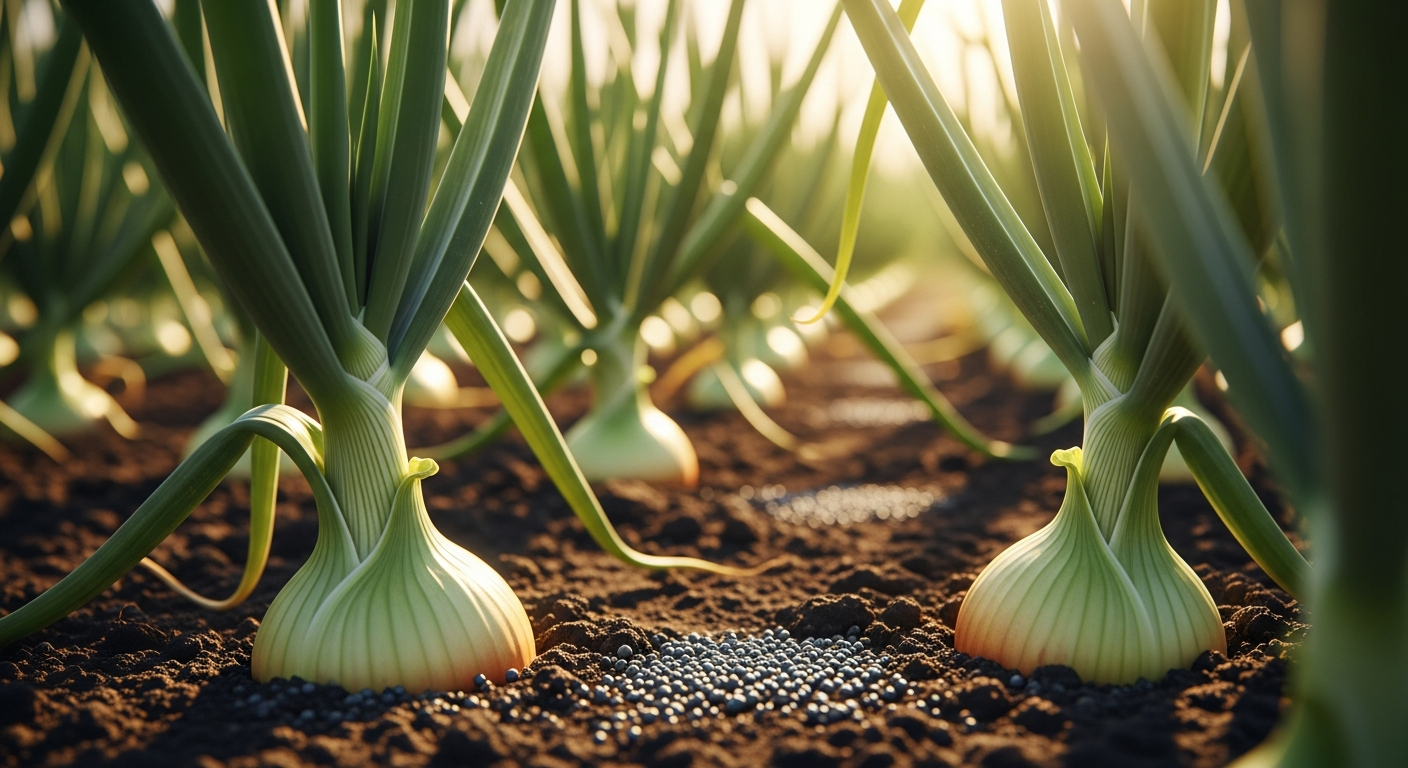
Fertilizers for onions are essential in producing healthy plants, large bulbs, and increasing yield. Onions require significant levels of nutrients to be successful; they cannot thrive without appropriate fertilizers. If there is no adequate supply of nutrients for the grower's onions, they typically produce weak root structures (ex. binder onions) and thin green leaves because they have been growing on insufficient amounts of fertilizer for an extended period of time. By supplying a balanced amount of nutrients to the onion crop during the initial vegetative growth period, an onion crop will develop a solid base for quality, healthy, vigorous bulbs.
The best fertilizers for producing onions contain nitrogen for leafy growth, phosphorus to produce healthy root systems and bulb size, along with potassium for overall plant health, plant disease resistance or overall fitness of the plant. Providing appropriate fertilizer at the proper growth stages of the onion crop provides consistent uptake of nutrients assisting the plant with the process of photosynthesis which helps in consistent bulb mass throughout the growing season.
Fertility for onion crops has been specifically formulated for onion crops in order to maximize nutrient recovery, will not place excessive demands on the soil and thus assist the plants in achieving optimal nutrient recovery which also has a positive effect on the ability of the soils to support plant growth. Since onions develop shallow roots, fertilizers that are readily available to plants provide growers the opportunity to reduce nutrient loss and improve efficiency in overall productivity, to support the development of healthy soils.
Choosing to use the correct fertilizers for onions, will improve several bulbing quality characteristics (size/weight), along with aiding in storage quality of the harvested bulbs and improve overall market value of the harvested bulbs will be very apparent within the growers.
Understanding the Nutritional Needs of Onions
Onions are very demanding crops with set needs at all phases of development. An appropriate onion fertilizer will promote even growing and leaf development; establish solid roots; develop bulb size appropriately. It’s essential that nutrients are available within the soil because onions have very short root systems. Without a good selection of onion fertilizer, nutritional deficiencies can occur and prevent even production across the entire growing area.
To maximize your onion production and to develop high-quality onions; balanced nutrition is key. The two types of nutrients (macro or large amounts and micro or small amounts) complement one another, and understanding what type of onion yields to expect with the fertilizer applied will help growers achieve optimum yield potential; develop larger bulb size and superior storage quality.
Essential Macronutrients for Onion Growth
Macronutrients are required in larger quantities and directly influence onion plant structure and productivity. A quality onion fertilizer supplies these nutrients in the right proportion.

Role of Micronutrients in Onion Farming
Some micronutrients may be necessary in smaller amounts, but they play a very important role in enzyme activity, nutrient transportation and a plant's immunity. If a plant is lacking micronutrients (even if the macronutrients are sufficient), the yield will be severely impacted.

A properly formulated onion fertilizer will incorporate all of these micronutrients so that growth disorders, yellowing leaves and variable bulb shapes will not be evident in onions produced using it. Proper micronutrient balance is required for optimum fertilizer performance and, therefore, nutrient absorption for onion crops throughout the growing season.
Onion Growth Stages and Nutrient Demand
There is a shift in the nutritional requirements of an onion plant from planting until harvest so altering fertilizer on onions for each stage of development will provide better results:
- Early Stage of Growth: Lots of nitrogen is required to develop leaves and roots.
- Stage of Bulb Initiation: There is more phosphorus and potassium needed for developing a bulb.
- Stage of Bulb Development: Potassium helps the onion bulb to be larger and firmer while also making the plant more resistant to disease.
- Mature Stage: There is less nitrogen being applied to the onion plant at this stage to control overall foliage production and provide better storing onions.
Using the proper fertilizer for each stage of onion growth provides the best use of nutrients as well as healthier crops and greater marketable yields. Proper nutrient management will produce profitable and sustainable crops of fertilizer onions.
The Best Types of Fertilizer for Onions: Organic vs. Synthetic Options
Fertilizers Come in Two Different Forms (Organic and Synthetic). The use of fertilizer is a very important part of growing onions. When you choose the best fertilizer to grow onions, you will end up producing better quality pumps and greater yields. Both types of onion fertilizer will promote the healthy growth of onions, provided you apply them appropriately. To choose the best fertilizer for an onion crop, farmers must think about the condition of the soil, the growth stage of the crop, and their own productivity goals. By understanding the reactions of onions to the various sources of nutrients in the fertilizer, farmers can make better decisions regarding fertilization.
Both organic and synthetic fertilisers can be used to grow onions successfully. In order to have an ongoing supply of healthy onions for many years to come, the major consideration is how well these two forms of fertilizer supply immediate nutrients vs. long-term health of the soil.
Organic Onion Fertilizer and Soil Health Benefits
Organic onion fertilizer promotes good soil structure due to its ability to slowly release nutrients that are readily available for onion plants to obtain.
Major Benefits of Using Organic Fertilizer for Onion Production:
- Increases microbial activity in the soil and fertility.
- Increases water holding capacity and aeration of roots.
- Decreases the chance of nutrient burn in shallow-rooted onions
- Contributes to long-term soil health and sustainability.
Types of Organic Fertilizers that Onions Will Respond To:
- Farmyard Manure (FYM)
- Vermicompost.
- Compost & Green Manure.
- Neem Cake & Bio-Fertilizers.
For farmers looking to enhance soil quality over time, organic fertilizers provide a nutritious environment for onion crops to thrive. Organic fertilizers have a slower rate of releasing nutrients, but they also help to form a solid base to create uniformity in the growing of onions and to create better quality bulbs.
Synthetic Fertilizers and Recommended NPK Ratio for Onions
Synthetic fertilizers provide fast and precise nutrition, making them a popular choice for commercial onion farming. A balanced fertilizer for onion growth ensures rapid nutrient uptake and uniform crop development.

Choosing the Best Fertilizer for Onions Based on Soil Type
Your soil type is an important factor in the best onion fertilization method.
- Sandy Soil - Because of the leaching action, split application of synthetic fertilizers for onion production or continual organic feeding will give the best results;
- Clay Soil - Since clay holds nutrients well, using organic fertilizers will provide improved aeration and root penetration.
- Loamy Soil - This is the optimum environment for growing onions; therefore, the onion will receive optimal nutrition by using both organic and synthetic fertilizers.
The best way of achieving success is through Integrated Nutrient Management, which uses both forms of onion fertilizer to provide optimal short term nutrient supply to the plant and also will improve the soils' health long term, resulting in healthier plants, larger bulbs, and higher yields.
When and How to Apply Onion Fertilizer Effectively
Proper timing and correct methods for applying onion fertilizers are very important to the overall success of growing onions. Because onions grow in shallow soils with a short window of time to uptake nutrients lost, it is readily apparent that nutrients need to be available to the onion plant at the times when it uses the most nutrients.
Proper selection and application of fertilizer on onion crops will allow for proper nutrient absorption into the crop at all times through strong plant growth and maximum bulb formation. Properly scheduled application of fertilizers to onion crops will also help minimize nutrient loss and increase overall crop efficiency.Applying onion fertilizer in phases (pre-plant, during growth, and at onion bulb formation) will help provide onions with consistent nutrition over the entire crop cycle.
Pre-Plant Fertilization and Soil Preparation
Preparing the soil before planting is the very first step in producing a healthy crop of onions. It is done to improve the soil's fertility and structure before planting either transplants or seeds.
Steps To Take When Applying Fertilizer Before Planting Onions:
- Mix aged compost into the soil to improve the soil structure and texture
- Check the soil pH, 6.0 – 6.8 is the optimum range for good nutrient uptake.
- If the soil test results indicate deficiencies, add in micronutrients.
- Add a phosphorus fertilizer; it helps in developing strong roots before the onions get established.

Side-Dressing and Foliar Feeding for Onions
Onions require side-dressing to get the nutrients they need at their growth time. Nitrogen is a very important nutrient during the first part of growth.
Benefits of side dress fertilizer:
- Helps to develop leaves faster
- Prevents nitrogen deficiency from occurring
- Bulbs develop size indirectly by having good leaf growth
- Foliar feeding can quickly fix nutrient deficiency problems, usually for micro+nutrients.
Common foliar nutrients for fertilizer:
- Nitrogen - urea (low concentration spray)
- Zinc and iron - production of chlorophyll
- Potassium - bulb growing
Foliar applications should be used in addition to soil based fertilizers when growing onions.
Fertilizing Schedule for Maximum Bulb Development
A structured fertilization schedule ensures onions receive nutrients at the right time without overfeeding.

Avoiding Common Mistakes When Using Onion Fertilizer
Avoiding common mistakes when fertilizing onions is a key component to developing healthy onions with high yields. Many yield losses occur as a result of improper fertilizer practices rather than poor soil fertility. Inadequate, excess, or improperly timed applications of fertilizer for onions will negatively impact plant growth and ultimately affect bulb development and the onion's ability to be stored successfully. Awareness of these common mistakes allows onion producers to utilize fertilizer to grow onions more efficiently and sustainably.
Balanced nutrition, correct amounts of fertilizer and timely application of fertilizers will result in stress-free onions receiving the proper nutrients necessary to produce high quality vegetables.
Over-Fertilizing Onions and Fertilizer Burn Symptoms
Using large amounts of fertilizer for onions can lead to fertilizer burn (this is when the plant's roots cannot absorb all of the nutrients and they start to "burn") and can also lead to uneven growth.
Common signs of over fertilized onion plants include:
- Leaf tip damage due to burning/turning yellow before turning brown
- Overly lush and green foliage with minimal or delayed bulb growth
- Weak and narrow necks, resulting in poor storage quality
- Salt build up on the soil's surface
Causes of burn from fertilizers for onion plants include:
- Applying high rates at one time
- Using chemical (industrial) fertilizers on onion crops at concentrated levels
- Applying fertilizer when it is hot or dry.

Signs of Under-Fertilized Onion Plants
Inadequate amounts of fertilizer for onion crops will inhibit growth and result in reduced yield. If onion crops do not have enough of a nutrient, they will show signs of nutrient deficiency at an early stage.
Examples of Symptoms Associated With Poorly Fertilized Onions Are:
- Light yellow to pale green leaf colour from lack of nitrogen
- Slow growth and thin foliage
- Lack of root development
- Under-developed bulbs.
Correct Dosage and Timing of Fertilizer for Onion Crops
The correct timing and amount of done through the application of fertilizer on onion crops can make the difference between having a deficiency or toxicity in the end result.
Here are some best practices for fertilizing onions:
- Determine soil test recommendations before application.
- Apply fertilizer for onion crops using split applications.
- Reduce nitrogen application during the late growth stage.
- Do not apply any fertilizers to onions before heavy rains.

Troubleshooting Poor Growth: Is Your Fertilization Strategy Working?
If onion crop growth appears weak or bulb sizes are not uniform in size, then likely causes include an inappropriate onion fertiliser strategy. Even when fertilising frequently, onions can still suffer from nutrient deficiencies due to timing and formulation of product or inability to use nutrients properly. By reviewing the fertilisation program for each onion crop, gaps can be discovered in the application of fertiliser that can be corrected before any long term yield reduction occurs. In order for fertilised onions to reach their maximum potential, careful observation, soil sampling and corrective actions will be required.
Understanding what will happen with plants is a good way to begin correcting any fertilisation related issues with crops.
Yellowing Onion Leaves and Nutrient Deficiencies
Yellowing leaves are one of the most common signs that onion fertilizer management needs adjustment. Different deficiency patterns point to specific nutrient issues.

Fixing Stunted Growth and Poor Bulb Formation
Bad growth in onions can be caused by improperly balanced nutrients, or bad timing on fertilizers.
The two big issues that cause:
- Excess nitrogen during the end of the vegetative state of growth
- Not enough potassium during bulb development
- Compacted soil preventing root expansion
- Irregular application of onions fertiliser
Corrective measures:
- Reduce nitrogen after the vegetative state of growth
- Increase potassium-containing onion fertiliser during the enlargement of your bulbs
- Create more room for air and drainage in your soil
- Use a split application of the nutrients.
The balanced nutrition develops uniform growth and big bulbs.
Soil Testing, Crop Rotation, and Long-Term Soil Fertility
The long-term productivity of onions (Allium cepa) is determined not only by the choice of fertilizer but also by the health of the soil on which they are grown. Relying on only visual evidence to determine the health of a crop can create repeatable mistakes.
Below is a list of best practices for sustainable onions fertilizer management and use:
- Conduct soil testing prior to the beginning of crop production each year
- Rotate onions with legumes or non-allium crops when possible
- Add organic matter to improve soil structure
- Use a combination of organic and synthetic fertilizers for agricultural crops to maximize productivity.

FAQs
Q1. What is the best fertilizer for onions?
A balanced onion fertilizer with nitrogen, phosphorus, and potassium (NPK), especially higher potassium during bulb formation, works best for healthy growth and yield.
Q2. How often should fertilizer for onions be applied?
Fertilizer for onion crops should be applied in split doses every 2–3 weeks during active growth for better nutrient absorption.
Q3. Can organic fertilizer be enough for onions?
Yes, organic onion fertilizer can support onions well, but combining it with targeted nutrients often gives better and faster results.
Q4. Why are my onion leaves turning yellow?
Yellow leaves usually indicate nitrogen or sulfur deficiency, improper watering, or imbalance in fertilizer onions application.
Q5. What soil pH is best for onions?
Onions grow best in slightly acidic to neutral soil with a pH range of 6.0 to 6.8.
Conclusion: Transform Your Onion Yields—Take Action with the Right Fertilizer Today!
Applying the right onion fertilizer will have a positive and dramatic impact on improving the productive capacity of your crops. Onions have specific nutritional needs throughout their growing cycle; providing these with the proper fertilizer and correct timing will produce plants that are healthier, with better root systems and consistent bulb growth. Properly applied soil amendments (fertilizers, manures, composts) will also enable more nutrient uptake by your onions, reducing or eliminating many of the common growth problems typically associated with onions.
The combination of organic materials and targeted nutrient inputs is a balanced way to promote soil fertility while giving you an immediate return on your investment. When you understand what soil type you use, when your onions are in their various stages of growth, and how many nutrients your onions need, you will be able to maximize the weight, quality, and storability of your bulb onions. Proper fertilizing will also decrease waste, reduce input costs, and support the environmentally-friendly practices associated with sustainable agriculture.
If you continue to monitor plant health, conduct soil tests, and adjust your fertilizer program as necessary, you will increase your onion crop yield and, ultimately, receive a greater market return. Take action today to apply the proper fertilizer for your onion production needs; a smarter nutrition program for your onions will produce stronger crops and larger profits for you at harvest!