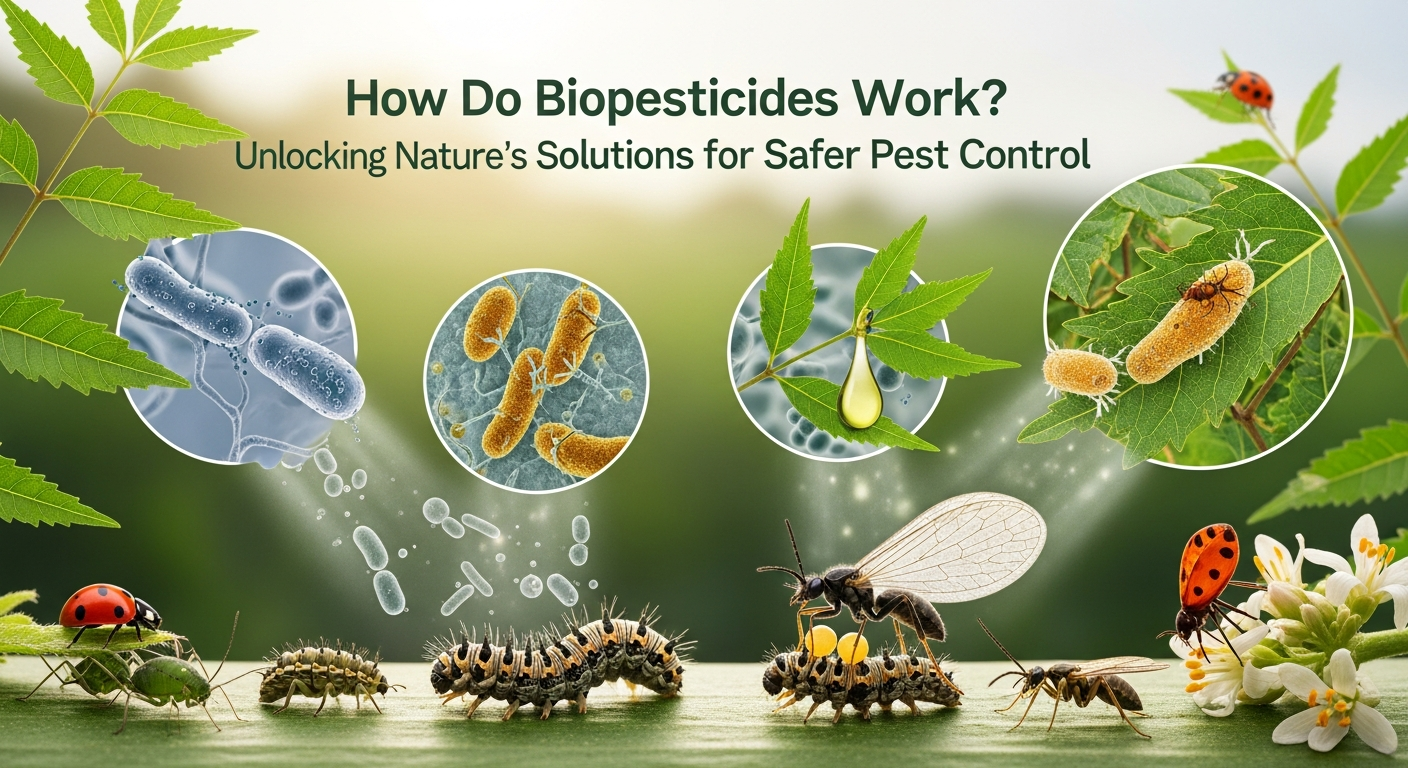
Biopesticides or natural pest control is the use of naturally derived products such as extracts from plants and specific organisms (like bacteria) as a means of pest control in an environmentally friendly manner. The question of how biopesticides work can be answered in terms of how they can influence farming and gardening practices towards a more eco-friendly and sustainable way of managing pests without damaging soil, water or beneficial organisms.
Unlike chemical pest control products, which rapidly kill insects on contact, biopesticides impact only specific pest insects and have a more subdued effect. They disrupt the life cycle of the target insect(s) through altering their growth and/or reproductive processes and/or by interfering with their ability to feed. This creates a more environmentally friendly pest management solution for crops and humans (in addition to the environment) while still maintaining their ability to control pest species and their associated diseases and insects.
Biopesticides play an important role in an integrated pest management system (IPM) for agricultural producers. Biopesticides contribute to enhancing plant protection (by enhancing plants’ immunity to pests), control impacts of pests with reduced overall use patterns, and contribute to improving the long-term condition of the soil, making them ideal applications for sustainable and organic farming operations.
There are a variety of biopesticides available, including microbial biopesticides, as well as plant-derived products. All applications of biopesticides are used in conjunction with nature, to help protect crops while minimizing the impact on the environment.
Understanding Biopesticides: What Are They and Why Are They Important?
Biological pest control agents, or biopesticides, are products used to help control pests without using synthetic chemicals. They share many characteristics with other pest control methods (e.g., efficacy, residual activity). Biopesticides also use living organisms or naturally occurring substances to help manage pest populations without the use of chemical pesticides.
Modern agriculture has increasingly focused on developing biopesticides for crop protection and environmental sustainability. Farmers across the globe have begun incorporating biopesticides into their farming practices as part of their efforts to improve soil quality, reduce environmental impacts, and protect crops. Biopesticide types vary greatly (e.g., bacteria, fungi, plant extracts) but all share specific traits that make them attractive for use in agricultural systems: they are naturally occurring; they are biodegradable; they have relatively low toxicity to humans, animals, and beneficial insects; and they will not develop resistance in target organisms.
Biopesticide Definition and Basic Concepts
Biopesticides come from natural sources, like bacteria, fungus, and plant materials, and are intended to control pests through prevention or management rather than a quick death. Non-chemical pesticides do not destroy all insects or other organisms that inhabit an area; they will interfere with the life cycle of the pest in question (e.g., cause it to reproduce less often), as well as helping to develop resistance and resistance to those pests.
Some of the basic concepts of biopesticides are:
- They will target specific organisms, not all!
- They will decrease/inhibit pest growth, feeding, and reproduction, allowing for lower pest levels!
- They will improve plant resistance through creating a more robust immune system!
- They will leave very little residue on crops and soils!
Biopesticides can:
- Biologically attack (infect or disable) pest populations!
- Act as natural repellent to keep pests away from the crop!
- Interrupt/modify the life cycle of pest populations so that over time they will disappear!
These characteristics of biopesticides are what make them a benefit for long-term, sustainable pest control!
Types of Biopesticides Used in Agriculture
There are three main types of biopesticides in agriculture, each working in a unique way:

Why Biopesticides Matter for Sustainable Farming
In terms of creating a safe and sustainable food system, biopesticides are vital. They not only control pests but also help with sustainable agriculture.
Why use biopesticides:
- Preserve beneficial bugs (bees) and other natural pest predators
- Reduce soil and water pollution
- Lower your chances of developing pest resistance
- Contributes to organic and environmentally content farming
- Improve the productive capacity of crops long-term
Biopesticides are used by farmers as part of Integrated Pest Management (IPM) to help control pests, combining natural pest control methods with smart agricultural practices. This gives farmers a balance between healthy foods, safe foods, and a healthier planet.
The Science Behind Biopesticides: Mechanisms of Action Explained
Biopesticides are based on established biological processes that are safer, smarter and more sustainable than conventional chemical pesticides. In order to understand how they function, it is vital to examine the relationships between biopesticides, (1) Pests, (2) Plants and (3) The Environment, both microscopically and ecologically speaking.
In the agricultural application of biopesticides; biopesticides do not aim to kill pests instantly; but rather the primary goal of biopesticides is to disrupt the pest's ability to survive and reproduce in a manner that protects beneficial or desirable organisms and maintains the overall health of the soil ecosystem.
How Do Biopesticides Work at the Biological Level?
Biopesticides function at the biological level by utilizing natural chemicals and microorganisms in order to interact biologically with target pests, rather than use toxic shock.

Pests are less likely to develop resistance because the methods employed by biopesticides are used in a precise and biological manner; this is one of the major benefits associated with biopesticides in agriculture.
Role of Biocontrol Agents in Pest Management
Biocontrol agents are living organisms used to kill or control pest populations without causing harm to the environment or human health. These agents are essential components of many biopesticides and have been extensively utilized within organic farming.
Common Biocontrol Agents:
- Microbes (e.g., specific bacteria that attack certain types of pest populations)
- Pathogenic fungi (i.e., infectious organisms that invade insect pests)
- Natural predators of insects and their parasites
- Virus strains that specifically target certain species of insect pests
Importance of Biocontrol Agents:
- They help maintain balance in ecosystems and are effective replacements for chemical pesticides.
- They reduce the need for chemical pesticides.
- They provide safe alternatives to traditional chemical pesticides for crops, farmers, and consumers.
- They are an effective part of IPM (Integrated Pest Management).
Biopesticides using biocontrol agents will help control and manage pest populations over an extended period rather than just providing immediate relief through application of chemical pesticides.
Target-Specific Action vs Broad-Spectrum Chemicals
One of the biggest scientific advantages of biopesticides is their target-specific nature.

Types of Biopesticides and Their Unique Working Methods
Biopesticides can be classified into different groups depending on their natural source and the way they control pests. Knowing these classifications will help you realize how biopesticides control pests in a different manner than conventional chemicals. Some biopesticides control pests directly while others work by enhancing plants’ health and helping to repel pests naturally. Regardless of how they work, biopesticides generally will work together for an environmentally safe and flexible approach to pest management.
Microbial Biopesticides and Their Mode of Action
Microbial biopesticides are derived from naturally occurring microorganisms (bacteria, fungi, virus or protozoan) and represent one of the largest commercial biopesticide groups being used today in modern agriculture.
Microbial biopesticide action:
- Infect specific insect (pest) after ingestion or contact
- Produce toxins that will stop the feeding and break down the insect’s digestive system
- Multiply inside the pest and cause slow mortality
- Safe for non-target organisms (e.g.; beneficial insects, people, animals)
Importance of microbial biopesticides in agriculture:
- Highly target-specific
- Minimal residues on food crops
- Very low risk (potential chance) of the pest developing resistance
Microbial biopesticides are commonly used to control lepidopterans, coleopterans and also control soil-borne diseases in agriculture.
Botanical and Biochemical Bio Pesticides
Biological and chemical biological pesticides are products that are made from either natural plant material or naturally occurring chemicals/compounds. While they don’t typically cause instant death of a pest, they modify (through behavior modification) how a pest acts and survives.

Agricultural uses for these pesticides can include foliar applications and as initial treatment products in biological and chemical biological pest management.
Plant-Incorporated Protectants (PIPs) Explained
PIPs are produced from the natural development of biopesticidal substances by plants themselves. The plant develops ways to protect itself against pest damage through its use of genetic processes (either naturally or through bio-based means).
Biopesticides Use Biopesticidal Proteins as PIPs
- Biopesticides are only toxic to certain target organisms.
- When an organism consumes the biopesticide of the plant, it will die.
- No need for an external application of pesticides.
- Protection will remain on the plant for its life.
Why PIPs Are An Effective Way To Control Pest Populations
- High specificity for specific insects.
- Less need for reapplication.
- Long term control of pest populations.
PIPs represent a significant technological advancement in biopesticides, enabling growers to decrease their reliance on chemical inputs, while continuing to achieve comparable yields.
The Benefits of Using Biopesticides Over Conventional Pesticides
As agricultural methods evolve towards being safer and more sustainable, biopesticides are being regarded as viable substitutes for the habitual use of chemical pesticides. Understanding the mode of operating for biopesticides will allow better appreciation as to why biopesticide applications provide sustained benefits to the environment without degrading ecosystems. The usage of biopesticide solutions in agricultural products protects crops and preserves environmental balance by providing a natural form of protection with a focus on prevention, precision and sustainability, as opposed to providing short-term chemical solutions.
Environmental and Soil Health Benefits
Biopesticides have numerous environmental and soil health benefits----especially for the environment.
The key environmental benefits of Biopesticides include:
- Biodegradable and naturally break down.
- No contamination of soils or groundwater as a result of their use.
- The preservation of beneficial soil microbes.
- The improvement of soil fertility and structure over time.
How do biopesticides impact soil health?
Biopesticides support the growth and activity of natural microbes, keeping the soil alive and productive. Chemical pesticides sterilise the soil, while biopesticides will promote nutrient cycling and root-zone health, thus making biopesticides excellent for sustainability in agriculture.
Safety for Farmers, Consumers, and Non-Target Species
While all pesticides are designed for safety, biopesticides have a much greater level of safety than do conventional pesticides because they are targeted pesticides.

Farmers are able to apply biopesticides and have lower amounts of protective equipment while still providing adequate pest control. Because of this, biopesticides can be used on Organic and or Residue Free farming systems.
Resistance Management and Long-Term Effectiveness
Repeated application of chemical pesticides can create pest resistance. Biopesticides provide a more intelligent, sustainable, long-term solution.
How biopesticides manage resistance:
- They have many modes of action that are biological.
- They work on the life cycle of a pest and not the nervous system.
- They reduce the selective pressure on pests (or their ability to develop resistance).
- They provide long-term effectiveness when using multiple applications.

Biopesticides in Integrated Pest Management (IPM)
Integrated pest management (IPM) is an integrated or holistic approach to managing pests through biological, cultural, mechanical, and chemical strategies that are sustainable. In this context, biopesticides form the backbone of an effective and successful IPM programme, as their mode of action is consistent with the prevention rather than elimination principle.
Therefore, understanding how biopesticides function enables us to see the reason they have been embraced by many agricultural users as alternative, effective and environmentally safe methods of dealing with pest problems. Biopesticides add value to IPM systems by allowing for less chemical dependency while ensuring and maintaining effective pest control.
Biopesticides in Integrated Pest Management (IPM)
In an IPM, the use of biopesticides is a primary means to address the pest issue, or as an adjunct option when all of the other options have been exhausted.
Biopesticides serve four purposes in IPM, which are:
- To suppress pest populations before they reach damaging levels
- To target specific pest species with no harm to beneficial insect populations
- To complement cultural management strategies such as crop rotation
- To limit the number of chemical applications made to crops to keep pests under control
Use of Bio Pesticides in Organic and Natural Farming
Biopesticides have important roles to play in organic and natural farming systems as synthetic pesticides are either banned or limited in those types of systems.
Why Biopesticides Are So Important for Organic Agriculture
- Biopesticides are derived from natural sources (plants or organisms).
- Biopesticides are permitted by the standards for organic certification.
- Biopesticides typically leave little or no chemical residues.
- Biopesticides are safe for farmers who apply them, as well as for consumers who consume the treated crop.
Organic growers use biopesticides in order to manage insects and weeds, as well as diseases, while maintaining soil biodiversity and healthy crops. This is done by using microbial, botanical and biochemical types of biopesticides in continuing their production methods.
Successful Crop Protection Examples from Agriculture
Biopesticides are highly effective on many different types of crops and under a variety of different agriculture environments.
Some examples from actual experience include:
- Microbial biopesticides to manage caterpillars in vegetable production
- Botanical biopesticides to manage aphids and whiteflies
- Biological controls for soil-borne fungal diseases
- Pheromone-based biopesticides to interrupt the mating of pest insects
These examples illustrate that biopesticides provide practical and dependable crop protection while posing no hazard to the environment.

The Future of Pest Management: Innovations in Biopesticides
Pesticide management in agriculture is rapidly evolving toward using safer and more environmentally responsible pest control methods. The use of biopesticide products is emerging as a prime example of this transformation. Technological advances have allowed us to expand our knowledge about how biopesticides work from a biological perspective to now include details about the use of advanced technology that can improve the effectiveness, longevity, and field performance of biopesticides.
The result has been doing away with the assumptions about biopesticides being unreliable and unscalable in agriculture and can be relied upon today as a materially different type of pest control solution.
Advances in Biocontrol Technology
Recent advancements in biocontrol technology have greatly improved the accuracy and efficacy of biopesticides.
Major advancements in biocontrol technologies include:
- The development of very specific beneficial microbes
- Higher volume of production for microbial strains
- Better formulations with longer shelf life
- Precise application methods such as seed treatment and soil applied
Next-Generation Bio Pesticides and Formulations
The new generation of biopesticides has improved efficacy, ease-of-use and compatibility with modern farming systems.
Innovations in the way we formulate our bio pesticides include:
- Microencapsulation to provide controlled release
- Combination products with more than one mode of action
- Liquid and nano formulations for improved absorption
- Weather resistant formulations for stability when used in the field
Reasons for this improvement:
These enhancements have improved the function of biopesticides under real world application conditions (i.e. reduced application rates and increased efficacy), making biopesticides a viable option for many growers facing unforgiving environmental conditions.
Trends Driving Biopesticides in Agriculture
Ongoing worldwide and agricultural development continues to drive Kogan Biopesticide's positive worldwide growth through:
- Growing demand for organic and no residue food
- Regulatory restrictions on the use of chemical pesticides by all governmental entities
- An increased awareness of the contribution of soil and environmental health to our future
- Placing biopesticide products into Integrated Pest Management (IPM).
- The consumer demand for sustainable agriculture.
These continual developments will lead to more extensive developments throughout the world with a greater investment in biopesticide product development for many years to come.

FAQs
Q1. How do biopesticides work compared to chemical pesticides?
Biopesticides work biologically by targeting specific pests or disrupting their life cycles, while chemical pesticides kill pests instantly using toxic substances.
Q2. Are biopesticides effective in large-scale agriculture?
Yes, biopesticides are widely used in large-scale farming, especially when integrated with IPM systems for consistent and sustainable pest control.
Q3. What are the main types of bio pesticides?
The main types include microbial biopesticides, botanical and biochemical biopesticides, and plant-incorporated protectants (PIPs).
Q4. Are biopesticides safe for humans and animals?
Yes, biopesticides are generally low in toxicity and are safe for humans, animals, and beneficial organisms when used as directed.
Q5. Are biopesticides suitable for organic farming?
Absolutely—most biopesticides are approved for organic farming because they are derived from natural sources and leave minimal residue.
Conclusion: Embrace the Power of Biopesticides for a Healthier Planet and Safer Food Supply
Biopesticides signify an important change in protecting our crops and producing food. Upon learning how biopesticides operate, it becomes evident that these biologically based solutions do more than just provide protection against pests. They encourage healthy soil, safeguard beneficial species, and limit environmental pollution. Also, biopesticides complement and work with the environment instead of being in conflict with it, as typical chemical pesticides.
Farmers utilizing biopesticides in agriculture can utilize both biologically based and plant-derived products to produce sustainable yields while protecting human health and wildlife. Being targeted, having low residues found on the crop, and complying with Integrated Pest Management (IPM) make biopesticides suitable for large-scale and organic farms. In addition, biopesticides help slow the development of resistance in pests, thus extending their time of efficiency and increasing the capacity for surviving crops.
Due to the worldwide demand for safe, residue-free, and environmentally sound food sources, using biopesticide as a means to provide healthy food for everyone will become mandatory. Working together (i.e., farmers, consumers, and politicians), the utilization of biopesticide products may help create a healthier environment, safer food sources, and a sustainable environment for future generations .