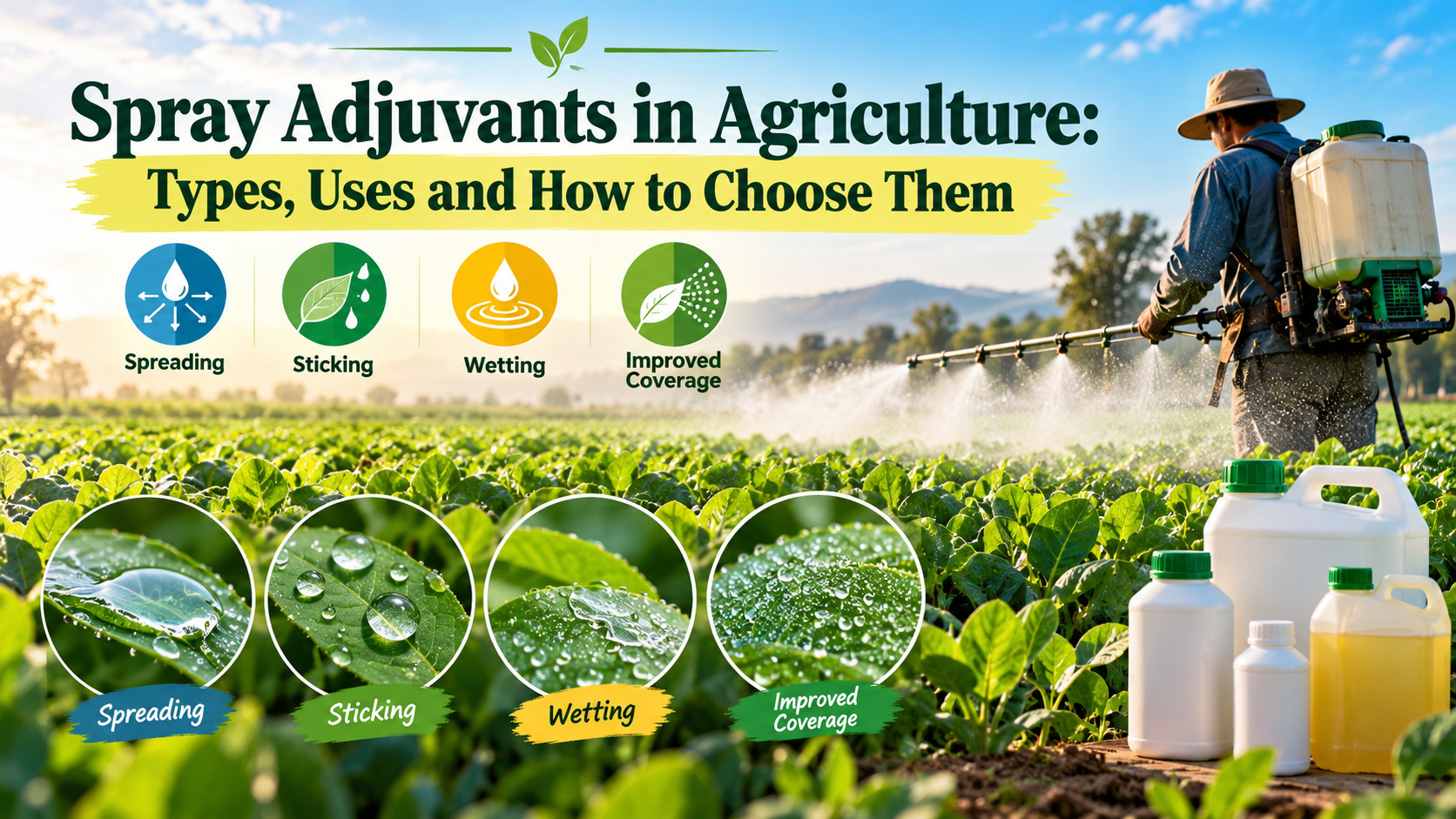
Spray a plain pesticide mix on a waxy leaf, such as onion or cabbage, and much of it beads up into round droplets that roll off before they can work. Spray adjuvants are the tank-mix additives that fix problems like this. A spreader flattens the droplets so they cover the leaf, a sticker helps the deposit stay on through rain or irrigation, and a water conditioner protects the pesticide from hard water. Used well, they help each spray do the job you paid for. Used carelessly, they add cost and can even cause crop injury. This guide explains the main types of spray adjuvants, how to match one to the problem in your field, and how to add a spreader to your tank the right way.
What Are Spray Adjuvants?
An adjuvant is a substance added to a spray mixture to improve how a pesticide performs or how easily it can be applied. On its own, an adjuvant does not control pests, diseases or weeds. Its value comes entirely from what it does to the spray.
Formulation adjuvants and tank-mix adjuvants
University of Wisconsin crop specialists split adjuvants into two groups. Formulation adjuvants are already built into the pesticide by the manufacturer. Spray adjuvants, often called tank-mix adjuvants, are separate products that the farmer or applicator adds to the tank. That difference matters: many pesticides already contain surfactants, so adding another one is not always necessary.
Activator and utility adjuvants
Spray adjuvants are further divided by what they do:
- Activator adjuvants improve how well the pesticide works. Spreaders, wetting agents, penetrants and oils fall into this group.
- Utility (special-purpose) adjuvants make the spray easier to apply or more reliable. Water conditioners, buffers, drift control agents and compatibility agents are examples.
The Main Types of Spray Adjuvants
Each type solves a different spraying problem. Knowing what each one does makes it much easier to pick the right product and avoid paying for one you do not need.
Spreaders and wetting agents
Spreaders and wetting agents are surfactants. Texas A&M AgriLife Extension describes them as additives that lower the surface tension of the spray mixture. Lower surface tension means each droplet flattens and spreads over a larger area of the leaf instead of sitting as a bead. Texas A&M also notes that most herbicide labels that call for a surfactant ask for a non-ionic type.
Silicone (organosilicone) spreaders
Silicone spreaders, also called organosilicone or super spreaders, are a stronger class of surfactant. Texas A&M describes them as giving a tremendous reduction in water surface tension, so a small droplet can spread across a far wider area than it would with a conventional spreader. Research on organosilicone adjuvants by Roggenbuck and Penner at Michigan State University found that they can also speed up absorption into the leaf and shorten the rain-free period needed after spraying. The same research stresses that the benefit depends on the pesticide and the plant species involved, so results are not identical across crops.
Bulk Agro Chem stocks two trisiloxane-based silicone spreaders: Silicon Super Spreader Formulation and Trisiloxane Ethoxylate Spreader.
Stickers
Stickers, also called deposition aids, help the pesticide adhere to the leaf surface. Texas A&M notes that they reduce runoff of the spray from the target plant, and Wisconsin's guidance adds that they cut the amount of pesticide washed off by rain or irrigation. Many products sold as spreader-stickers combine both actions in one bottle.
Oils and penetrants
Oil-based adjuvants help the spray move through the waxy outer layer of leaves. Crop oil concentrates usually contain 80 to 85% petroleum or vegetable oil plus 15 to 20% surfactant, according to Texas A&M. They are powerful, but University of Florida weed scientist Jason Ferrell cautions that crop oils can increase crop injury, and that high rates can burn leaves because they dissolve leaf waxes.
Water conditioners, buffers and acidifiers
The water you spray with can weaken the pesticide before it ever reaches the crop:
- Water conditioners are used where hard water is a problem. Ferrell names ammonium sulphate as the most useful one, especially with glyphosate, and notes it must go into the tank before the herbicide.
- Buffers and acidifiers stabilise or lower the pH of the spray water. Wisconsin's guidance notes that most pesticides perform better in slightly acidic conditions and that mixtures at pH 7 or above face a greater risk of breakdown. Ferrell adds that a pH modifier may not be needed unless the water pH is above 8, so test your water and check the pesticide label before adding one.
Drift control agents
Drift control agents make spray droplets larger, so fewer fine droplets are carried away by wind onto neighbouring crops. Ferrell notes the trade-off: some of these products can thicken the spray solution and block nozzle tips.
Compatibility agents
When two or more products are mixed in one tank, they do not always combine smoothly. Compatibility agents help keep the mixture evenly suspended. If you are unsure whether two products will mix, run a jar test before filling the full tank.
Which Adjuvant Solves Which Spray Problem?
Start with the problem you are seeing in the field, then match it to the adjuvant type. Always check the pesticide label first, because it may already recommend or rule out a specific adjuvant.
| Problem in the fieldAdjuvant type to considerWhat to watch | ||
| Spray beads up and rolls off waxy leaves | Spreader or silicone spreader | Use the label dose; more is not better |
| Spray washes off with rain or irrigation | Sticker or spreader-sticker | Check whether the pesticide already contains one |
| Weak results with hard bore-well water | Water conditioner | Add it to the tank before the pesticide |
| Alkaline spray water | Buffer or acidifier | Test the water pH first |
| Spray drifting onto nearby crops | Drift control agent | Can thicken the mix and block nozzles |
| Two products separating in the tank | Compatibility agent | Run a jar test before mixing a full tank |
How to Use a Spreader in Your Spray Tank
A spreader is the adjuvant most farmers reach for first. Using it correctly comes down to four habits.
Read the pesticide label first
Wisconsin's extension guidance puts it plainly: read the pesticide label, and follow any adjuvant instructions on it. If the label names a specific adjuvant or says not to add one, follow that. Some pesticides already contain enough surfactant, and adding more can raise the risk of injury on sensitive crops.
Measure the dose carefully
Silicone spreaders are used in very small amounts, and the right dose depends on the product's strength. Bulk Agro Chem's product pages, for example, give 5 ml per 15 litres of water for Silicon Super Spreader Formulation and 1 ml per 15 litres for Trisiloxane Ethoxylate Spreader. Use a measuring cup or syringe rather than pouring by eye, and follow the label of the exact product in your hand. Ferrell notes that going above the recommended rate does no good.
Add it at the right point in the mix
A common rule for tank mixing is to add surfactants such as spreaders near the end, after the pesticides have mixed in fully, unless the label says otherwise. Water conditioners are the exception: they go in early, before the pesticide. For the full sequence by formulation type, see our guide to pesticide formulation types and tank mixing order.
Spray at the right time
Bulk Agro Chem's spreader product pages recommend spraying in the early morning. Keep the tank agitated, spray soon after mixing, and avoid windy conditions that carry fine droplets off target.
Common Mistakes With Spray Adjuvants
Most adjuvant problems come from using too much or using the wrong type. Watch out for these:
- Doubling the dose: extra spreader adds cost without adding benefit, and it can increase the risk of injury on tender crops.
- Adding a spreader that the pesticide already contains: check the label and formulation before adding another surfactant.
- Mixing many adjuvants at once: Ferrell warns that adjuvant cocktails are usually more costly and give little benefit. Choose the one that matches your real problem.
- Using crop oils at high rates in hot weather: oils dissolve leaf waxes and can scorch leaves.
- Skipping the jar test for new combinations: a small test in a glass jar is far cheaper than a blocked sprayer or a ruined tank.
- Treating a new crop without a trial patch: before using a new adjuvant on a sensitive or high-value crop, spray a small area first and check it over the next few days.
Buying Spreaders and Adjuvants in Bulk
For dealers, farm groups and large growers, adjuvants are one of the easiest inputs to stock because a small volume treats a large area. A few checks keep that stock reliable:
- Check the label details: look for the composition, the dose per 15 litres or per acre, the batch number and the expiry date.
- Compare products by dose, not by bottle price: a product used at 1 ml per 15 litres covers far more tanks than one used at 5 ml, so compare the cost per tank.
- Store them properly: keep adjuvants in their original closed containers in a cool, dry place away from children, and mix well before use.
- Confirm bulk terms: Bulk Agro Chem's spreader product pages show a 50-unit minimum order with lower per-unit prices at higher quantities. Confirm pack size, stock and transport charges before ordering.
Frequently Asked Questions
What is a spray adjuvant?
A spray adjuvant is any product added to a pesticide or foliar spray to improve how it performs or how easily it can be applied. Spreaders, stickers, oils, water conditioners and drift control agents are all spray adjuvants.
What is the difference between a spreader and a sticker?
A spreader lowers surface tension so the spray covers more of the leaf. A sticker helps the spray stay on the leaf and resist wash-off from rain or irrigation. Some products combine both actions.
Is a silicone spreader better than a normal spreader?
A silicone spreader lowers surface tension much more than a conventional spreader, so it spreads the spray more widely and is used at very low doses. It is not automatically better for every spray, though. The benefit depends on the pesticide and the crop, so follow the pesticide label.
How much spreader should I add to a 15-litre sprayer?
Follow the label of the product you are using, because strength varies. Bulk Agro Chem's product pages give 5 ml per 15 litres for Silicon Super Spreader Formulation and 1 ml per 15 litres for Trisiloxane Ethoxylate Spreader.
Can I add a spreader to every pesticide spray?
No. Some pesticide labels already include a surfactant or advise against adding one. Always read the label first, and test a small area before using a new adjuvant on a sensitive crop.
When should a spreader be added to the tank?
Usually near the end of mixing, after the pesticides have dispersed fully, unless the label says otherwise. Water conditioners are different and should be added early, before the pesticide.
Conclusion
Spray adjuvants are small additions with a big effect on every tank. Start with the problem you are seeing, choose the one adjuvant type that solves it, read the pesticide label, and measure the dose instead of guessing. A spreader that is matched to the crop and used at the right rate helps each spray cover the leaf properly, so you get more value from every litre of pesticide you buy.
Need spreaders in bulk? Browse Bulk Agro Chem's spreader range, or message the team on WhatsApp for bulk pricing and availability.
This article is general information. Always read and follow the pesticide and adjuvant labels, and seek local agronomic advice for your crop.