
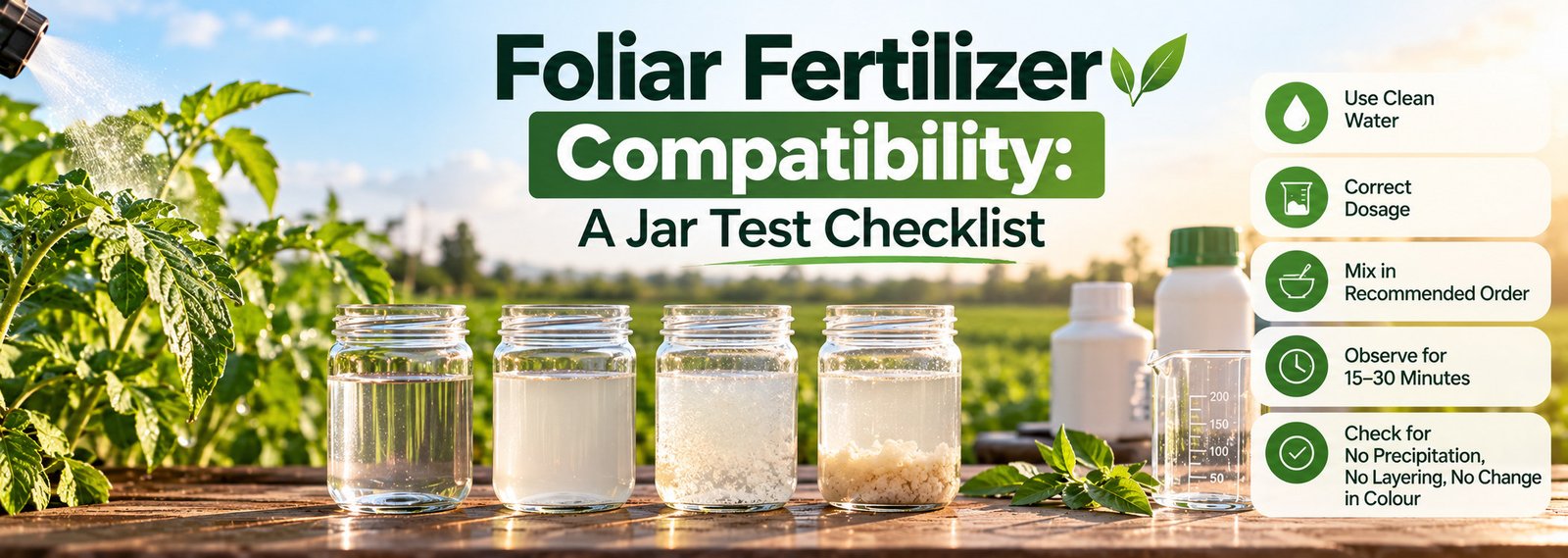
Foliar fertilizer compatibility matters whenever farmers plan to combine micronutrients, water-soluble fertilizers, biostimulants or crop-protection products in one spray tank. Even a useful input can create problems when paired with an unsuitable formulation or water source. The result may be sediment, clogged nozzles, uneven application or an unexpected crop response. This practical guide shows how a small-scale jar test can identify visible physical incompatibility before a full tank is prepared.
Why Foliar Fertilizer Compatibility Matters
Foliar feeding places a nutrient solution on plant foliage. Combining inputs may reduce separate spray passes, but convenience does not establish compatibility. A blend that looks uniform at first can separate after standing. More importantly, a blend that remains visually uniform may still be chemically incompatible or unsafe for a particular crop. Always follow every product label and written manufacturer guidance.
Physical versus chemical compatibility
Physical compatibility describes whether the mixture stays sufficiently dispersed for even spraying. Chemical compatibility concerns reactions that can alter ingredients or product performance. A jar test checks primarily the first category: it is not proof of crop safety, biological efficacy or legal permission to combine products.
What to Check Before Mixing Foliar Nutrients
Read all applicable labels
Confirm crop, growth stage, application method, permitted partners, required water conditions, personal protective equipment, mixing sequence and any restrictions. If a label prohibits a combination, do not use it—even if a jar test appears successful.
Inspect your water source
Use the same water that will fill the sprayer. Hardness, pH, turbidity and temperature can affect how formulations dissolve or disperse. If a manufacturer specifies a water-conditioning procedure, follow it exactly; do not assume that adding acid or an adjuvant will fix an unsuitable combination.
Understand each formulation
A water-soluble fertilizer, suspension concentrate, emulsifiable product and powder may behave differently. Do not pour concentrates directly together. Product-specific label directions take priority over any generic mixing order.
How to Perform a Foliar Fertilizer Jar Test
A jar test simulates the proposed spray mixture on a small scale. Use a suitable clear, closable container and follow manufacturer instructions for any hazardous materials. Wear the personal protective equipment required by the most restrictive label.
- Measure representative carrier water. Partially fill the test container with the same water used in the field.
- Calculate scaled quantities. Add each planned input at the same concentration that would be used in the spray tank. Use accurate measurements; do not estimate by eye.
- Follow the label mixing order. Add one material at a time and mix thoroughly after each addition. If instructions conflict, seek manufacturer advice rather than guessing.
- Observe the mixture. After mixing, allow it to stand for approximately 15–30 minutes, or for the duration directed by the relevant product guidance.
- Inspect again. Check for precipitates, flakes, gels, persistent layers, excessive foam or deposits. Note whether ordinary agitation restores uniformity.
- Make a conservative decision. Do not proceed with a mixture that forms persistent sludge, hard deposits or other signs of incompatibility. Do not treat a clear jar as proof of overall safety.
Important: Dispose of the test mixture according to product labels and applicable local regulations. Never empty agrochemical mixtures into drains, canals or irrigation water.
Common Warning Signs and What They Mean
| What you seePossible concernPractical response | ||
| Cloudy particles or crystals | Precipitation or incomplete dissolution | Stop and check formulation and water conditions |
| Sticky gel or sludge | Serious physical incompatibility | Do not prepare the tank mix |
| Oil layer or persistent separation | Emulsion instability | Check label and manufacturer guidance |
| Persistent foam | Formulation or agitation issue | Investigate before filling the tank |
| Uniform-looking liquid | No obvious physical failure | Still verify chemical, crop and label compatibility |
Practical Checklist for Farmers and Dealers
Before recommending or using a new foliar combination, keep a simple record of the crop, growth stage, product names, formulation types, batch numbers, rates, water source, mixing sequence, test observations and manufacturer advice. This record can help identify why a mixture behaved differently between farms or seasons.
- Never use a jar test to override prohibited label combinations.
- Keep measuring vessels clean and dedicated to agrochemical work.
- Check the sprayer tank, filters and nozzles before a new mixture.
- Where the label permits and local guidance recommends, evaluate an unfamiliar combination on a small test area before wider use.
- Seek qualified agronomic advice if crop sensitivity or compatibility is uncertain.
Frequently Asked Questions
Can I mix zinc and boron foliar fertilizers together?
Compatibility depends on the exact formulations, concentrations, carrier water and labels. Do not assume products are compatible merely because they supply micronutrients. Obtain product-specific guidance and conduct a jar test where appropriate.
Does a successful jar test prove the mixture is safe for leaves?
No. It primarily screens for visible physical incompatibility. A mixture that stays uniform can still cause crop injury or reduce performance.
How long should I observe a jar test?
Many university extension guides recommend observing for about 15–30 minutes, sometimes followed by another mixing-and-observation period. Follow the applicable product directions.
Can fertilizer and pesticide products share one spray tank?
Sometimes, but only when applicable labels, compatibility guidance and crop-use conditions permit it. Do not assume all fertilizers and pesticides can be combined.
What should I do if flakes or gel appear?
Do not scale the mixture up into the sprayer. Consult the manufacturers about alternatives and arrange safe disposal of the test contents.
Does changing the mixing order solve every problem?
No. Correct order can prevent some formulation problems, but it cannot make every prohibited or fundamentally incompatible combination safe.
Conclusion: Test First, Spray with Confidence
A small jar test is a useful safeguard when assessing unfamiliar foliar nutrient combinations. The best practice combines proper label checks, suitable water, accurate measurements, careful observation and agronomic judgment. For information about agricultural input options and product specifications, visit Bulk Agro Chem.
Further reading: University of Florida IFAS: Ensuring Pesticide Compatibility in Tank Mixes; University of Nebraska–Lincoln Extension: Testing Pesticide Mixtures for Compatibility.
Educational information only. Follow applicable labels, regulations and local professional advice for all applications.