



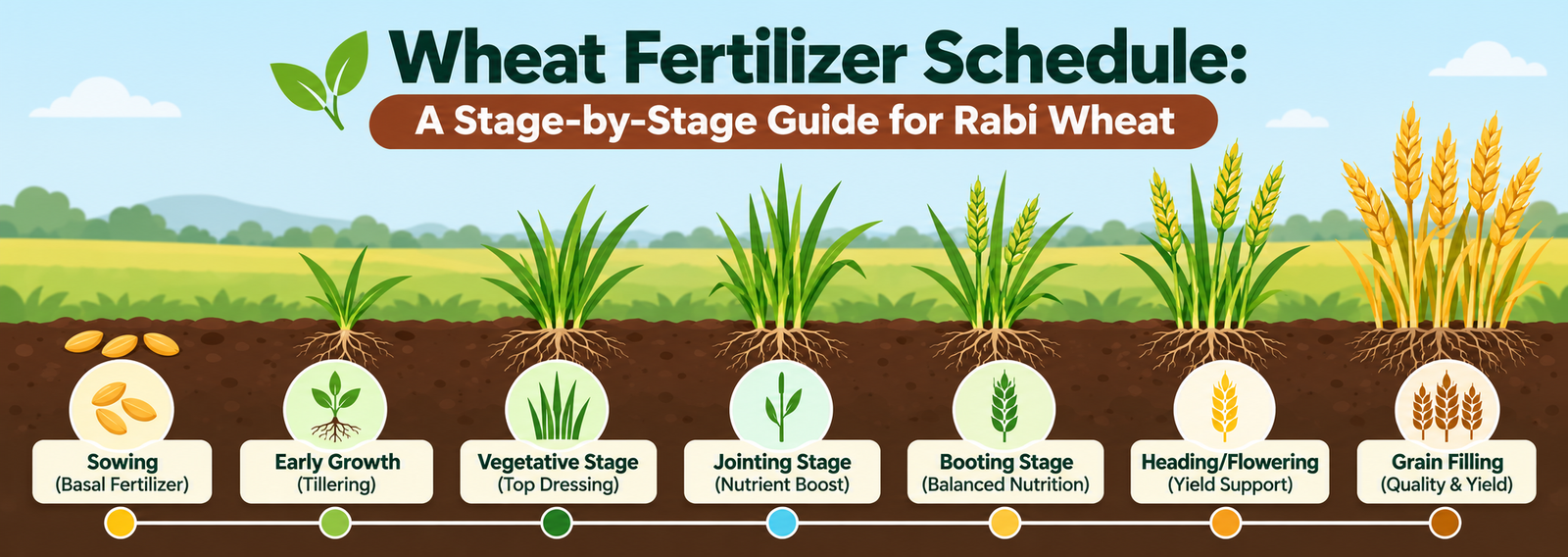
Wheat rewards good timing. The same bag of urea can give a strong crop or a weak one depending on when it goes in, and a hidden zinc or manganese shortage can hold back a field that has plenty of nitrogen. A clear wheat fertilizer schedule ties each nutrient to a stage of the crop: phosphorus and potassium at sowing, nitrogen with the first and second irrigations, and micronutrients when the soil or the crop shows a need. This guide walks through that schedule stage by stage, using Punjab Agricultural University's (PAU) Rabi 2025-26 package of practices as a worked example, and explains how to adjust it for your soil, sowing date and state.
Start With a Soil Test
Every fertilizer plan works better when it starts from what the soil already holds. PAU's package of practices asks farmers to apply fertilizer on a soil test basis, and to use its fixed doses only where no test is available.
Why a soil test changes the dose
A soil test tells you which nutrients to add and which to skip. PAU recommends potassium only where the soil tests low in it, and advises leaving out zinc for wheat if zinc sulphate was already applied to the preceding kharif crop. Skipping a nutrient the soil does not need saves money without costing yield.
Adjust for your region, soil and sowing date
The figures in this guide come from PAU and are written for Punjab conditions. Recommended doses differ between states and wheat-growing zones, so check the package of practices from your own state agricultural university or Krishi Vigyan Kendra. Two adjustments in PAU's guidance are worth knowing wherever you farm:
- Late sowing: for wheat sown after mid-December, PAU recommends 25% less nitrogen than for timely sown wheat.
- Sodic (kallar) soils: PAU recommends 25% more nitrogen than the standard dose.
Wheat Fertilizer Schedule at a Glance
For timely sown irrigated wheat on medium-fertility soil, PAU's dose works out to about 50 kg nitrogen and 25 kg phosphorus (P2O5) per acre. When phosphorus comes from DAP, the schedule looks like this:
| StageWhat to apply (per acre)Notes | ||
| Before sowing | 100 kg gypsum or 18 kg bentonite-sulphur (90%), if DAP is used instead of single superphosphate | Use 25 kg zinc sulphate (21%) only on zinc-deficient soils |
| At sowing | 55 kg DAP, drilled | No urea is needed at sowing when DAP is used. Add 20 kg muriate of potash only on soils low in potassium |
| First irrigation | 45 kg urea, broadcast | 35 kg for wheat sown after mid-December |
| Second irrigation | 45 kg urea, broadcast | 35 kg for wheat sown after mid-December |
| As needed | 0.5% zinc sulphate or 0.5% manganese sulphate sprays | Only where deficiency is known or seen |
Source: PAU Package of Practices for Crops of Punjab, Rabi 2025-26. Follow your own state's recommendation where it differs.
At Sowing: Phosphorus, Potassium and Sulphur
The nutrients that move slowly in soil go in at or before sowing, so they are close to the roots from the start.
Drill phosphorus at sowing
PAU recommends drilling all the phosphorus at sowing. With 55 kg DAP per acre, the crop also gets a small amount of nitrogen at the start, which is why no separate urea is needed at sowing.
Add potassium only where the soil is low
Where a soil test shows low potassium, PAU recommends 12 kg K2O per acre, which is about 20 kg of muriate of potash. On soils with adequate potassium, it can be left out.
Cover sulphur when DAP replaces superphosphate
Single superphosphate supplies sulphur, but DAP does not. So when DAP is used, PAU recommends 100 kg gypsum or 18 kg bentonite-sulphur (90%) per acre before sowing. If gypsum was already applied to a preceding groundnut crop, PAU halves the gypsum dose to 50 kg. Gypsum can also be applied to the standing crop if sulphur deficiency appears later.
Nitrogen at the First and Second Irrigation
Nitrogen is where most of the timing decisions sit. Instead of putting it all in at sowing, PAU splits it across the first two irrigations, so the crop gets nitrogen as its demand grows.
Broadcast urea with each irrigation
For timely sown wheat, PAU recommends broadcasting 45 kg urea per acre with the first irrigation and another 45 kg with the second. The first irrigation in wheat is usually given around crown root initiation, roughly three weeks after sowing, so the first urea dose lands just as the root system is establishing.
Late-sown wheat needs less
For wheat sown after mid-December, PAU cuts the dose to 35 kg urea per acre with each of the two irrigations, in line with its advice to use 25% less nitrogen on late-sown wheat.
If the second irrigation is delayed
Rain can push back the second irrigation. In that case, PAU recommends broadcasting the second urea dose at 55 days after sowing. If water is standing in the field and broadcasting is not possible, it suggests two criss-cross sprays of 7.5% urea solution at 42 and 54 days after sowing instead.
Fine-tune with a leaf colour chart
PAU also offers a need-based method using its leaf colour chart (PAU-LCC). Under this method, 40 kg urea per acre goes in at the first irrigation (25 kg for late-sown wheat), and the second dose is set by leaf colour at the second irrigation, ranging from 15 to 55 kg per acre. This avoids applying more nitrogen than the crop needs.
Micronutrients: Zinc and Manganese
Micronutrients are needed in small amounts, but a shortage can limit yield even when NPK is right. Apply them where a soil test or crop symptoms show a need. For more detail, see our guide to micronutrient management for Rabi crops.
Zinc
On zinc-deficient soils, PAU recommends 25 kg zinc sulphate (21%) per acre, which lasts for two to three years. If deficiency shows up in the standing crop, it recommends a 0.5% foliar spray made from 1 kg zinc sulphate and 0.5 kg unslaked lime in 200 litres of water per acre, repeated two or three times at 15-day intervals.
Chelated zinc is another option for foliar feeding. Bulk Agro Chem's Zinc EDTA Chelated 12% product page gives 250 to 500 g in 200 litres of water per acre as a foliar dose. Follow the label of the product you use.
Manganese
For manganese deficiency, PAU recommends foliar sprays of 0.5% manganese sulphate (1 kg in 200 litres of water per acre). The first spray goes on two to four days before the first irrigation, followed by three more at weekly intervals on sunny days. PAU notes that soil application of manganese is not profitable, so stick to sprays.
Biofertilizer Seed Treatment for Wheat
PAU recommends treating wheat seed with a consortium biofertilizer. For one acre's seed, it advises mixing 500 g of consortium biofertilizer with one litre of water, coating the seed on a clean floor, drying it in the shade and sowing straight away. If the seed has also been treated with a pesticide, PAU asks for at least six hours between the pesticide treatment and the biofertilizer.
Our step-by-step guide to biofertilizer seed treatment for Rabi crops covers the method in more detail. Bulk Agro Chem's NPK Liquid Bio-Fertilizer, a consortium of Azotobacter, Bacillus and Frateuria strains, is labelled for soil application at 1 litre per acre.
Common Mistakes in Wheat Fertilizer Management
Most losses come from timing and guesswork rather than from the fertilizer itself. Watch out for these:
- Putting all the nitrogen in at sowing: splitting it across the first two irrigations matches the crop's demand.
- Using the same dose for late-sown wheat: wheat sown after mid-December needs about 25% less nitrogen.
- Forgetting sulphur when switching to DAP: DAP does not supply sulphur the way single superphosphate does.
- Applying potassium or zinc every year by habit: a soil test shows whether they are needed, and soil-applied zinc sulphate lasts two to three years.
- Applying manganese to the soil: PAU recommends foliar sprays because soil application is not profitable.
- Mixing biofertilizer with treated seed too soon: leave at least six hours after any pesticide seed treatment.
Frequently Asked Questions
What is the fertilizer schedule for wheat?
A typical schedule applies phosphorus (and potassium where needed) at sowing, splits nitrogen between the first and second irrigations, and adds zinc, manganese or sulphur where the soil or crop shows a need. PAU's Rabi 2025-26 package gives 55 kg DAP at sowing and 45 kg urea at each of the first two irrigations per acre for timely sown wheat on medium-fertility soil.
How much urea is needed for one acre of wheat?
Under PAU's recommendation for timely sown wheat with DAP, it is 90 kg urea per acre, split as 45 kg at the first irrigation and 45 kg at the second. Late-sown wheat gets 35 kg at each irrigation. Doses differ by state, so check your local recommendation.
When should urea be applied to wheat?
PAU recommends broadcasting urea with the first and second irrigations rather than at sowing when DAP is used. If the second irrigation is delayed by rain, it advises applying the second dose at 55 days after sowing.
Which micronutrients does wheat need?
Zinc and manganese are the most common concerns. PAU recommends soil-applied zinc sulphate on zinc-deficient soils, 0.5% zinc sulphate sprays for deficiency in the standing crop, and 0.5% manganese sulphate sprays for manganese deficiency.
Does wheat need sulphur?
Yes, where the phosphorus source does not supply it. When DAP replaces single superphosphate, PAU recommends 100 kg gypsum or 18 kg bentonite-sulphur (90%) per acre before sowing.
Should I reduce fertilizer for late-sown wheat?
Yes, for nitrogen. PAU recommends 25% less nitrogen for wheat sown after mid-December, which means 35 kg urea per acre at each of the two irrigations instead of 45 kg.
Conclusion
A good wheat fertilizer schedule is less about adding more and more about adding at the right time. Test the soil, drill phosphorus at sowing, split urea across the first two irrigations, cover sulphur when you use DAP, and treat zinc or manganese shortages where they actually exist. Adapt the doses to your state's recommendation and your sowing date, and the crop gets what it needs at each stage of the season.
Stocking up for the wheat season? Browse Bulk Agro Chem's fertilizer range, or message the team on WhatsApp for bulk pricing and availability.
This article is general information based on PAU's Rabi 2025-26 recommendations for Punjab. Doses vary by state, soil and variety, so follow your local agricultural university's guidance and the product labels.