

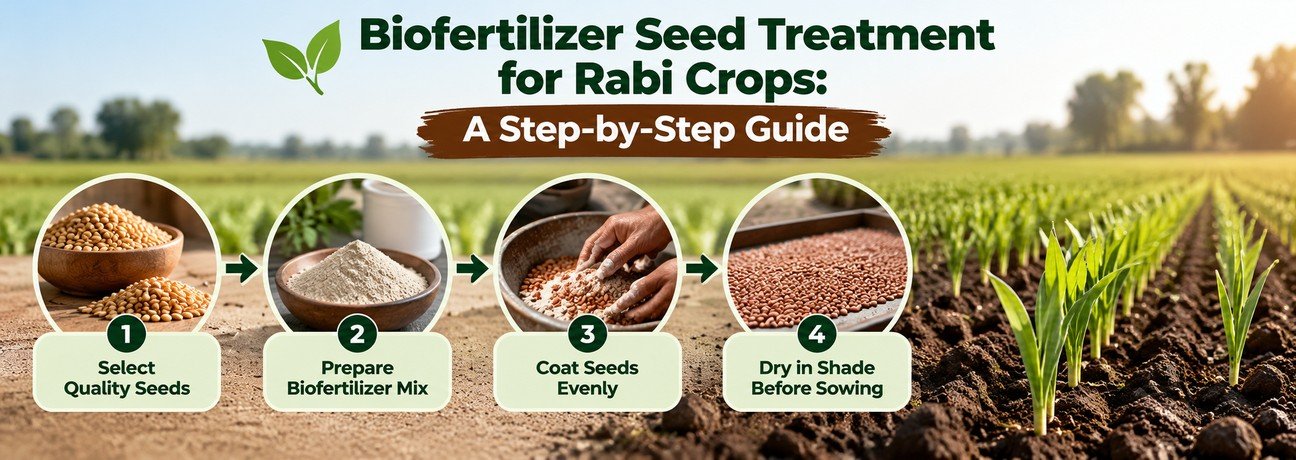
Rabi sowing is the one moment when a few grams of the right microbe can reach every single seed. Biofertilizer seed treatment coats each seed with living bacteria that fix nitrogen or free up phosphorus, so the young root meets a useful partner in the soil from the day it emerges. It costs little, takes an hour or two before sowing and fits easily into wheat, gram, mustard, lentil and pea programmes. This guide covers which biofertilizer suits each Rabi crop, how to treat seed with powder and liquid formulations, where Trichoderma and chemical seed dressings fit in the sequence, and the quality checks to make before you buy in bulk.
What Is Biofertilizer Seed Treatment?
Biofertilizers are preparations of living, efficient microorganisms that help crops take up nutrients through their activity around the roots. When they are applied to seed, the microbes go into the soil with it and colonise the root zone as the seedling grows. Seed treatment is the most widely used method because it is cheap, simple and places the inoculum exactly where it is needed.
How seed-applied microbes help a Rabi crop
Each group of biofertilizer does a different job:
- Rhizobium forms nodules on the roots of legumes and fixes nitrogen from the air. Tamil Nadu Agricultural University (TNAU) puts the nitrogen fixed by Bengal gram through this partnership at roughly 75 to 117 kg per hectare.
- Azotobacter and Azospirillum fix nitrogen around the roots of non-legume crops such as wheat, barley and mustard. Azospirillum also produces growth-promoting substances that support germination and early root development.
- PSB (phosphate solubilizing bacteria) release organic acids that dissolve bound phosphate in the soil, making more phosphorus available to the crop.
Biofertilizers and Trichoderma are not the same thing
Trichoderma is a beneficial fungus used as a biocontrol agent. It helps protect seed and seedlings against soil-borne fungal problems such as root rot, while biofertilizers supply or unlock nutrients. Many growers use both on the same seed, but in a set order, which is explained further down.
Which Biofertilizer to Use for Each Rabi Crop
The organism has to match the crop. Cereals and oilseeds need a free-living or associative nitrogen fixer, pulses need Rhizobium, and a phosphate solubilizer can be added to almost any crop. TNAU's recommendations for the main Rabi crops line up like this:
 |
Bulk Agro Chem stocks Azotobacter, Rhizobium and PSB in liquid form, with matching powder versions in the water insoluble bio-fertilizer range.
Why Rhizobium has to match the crop
Rhizobium is highly specific. Its strains are grouped by the legumes they can nodulate, known as cross-inoculation groups. A culture made for soybean or groundnut will not do the job on chickpea, so check the crop named on the pack before you buy or treat seed.
What You Need Before You Start
Getting the setup right takes a few minutes and protects the live microbes you are paying for:
- A fresh pack of biofertilizer, within its expiry date and kept out of the sun until use.
- A binder such as cooled rice kanji (rice starch water) if you are using a powder.
- A clean plastic sheet, tray, bucket or large plastic bag. Avoid metal trays and utensils.
- A shaded, airy place to dry the treated seed.
- Gloves, and clean seed that you can sow within a day.
How to Do Biofertilizer Seed Treatment Step by Step
The method depends on whether your biofertilizer is a powder or a liquid. Both are simple, and both rely on the same rules: an even coat, drying in shade and sowing soon after.
Method 1: Powder (carrier-based) biofertilizer
TNAU's standard method uses one 200 g packet of powder for 10 kg of seed:
- Mix one 200 g packet with about 200 ml of cooled rice kanji to make a smooth slurry.
- Spread the seed on a plastic sheet or in a tray and pour the slurry over it.
- Mix gently by hand until every seed carries a thin, even coating.
- Spread the seed in the shade and let it dry for about 30 minutes.
- Sow within 24 hours of treatment.
Because the rate is set per kilogram of seed, crops sown at high seed rates, such as wheat and chickpea, need more packets per acre than small-seeded crops like mustard.
Method 2: Liquid biofertilizer
Liquid biofertilizers are easy to measure and coat seed with less mess. TNAU's reference dose for seed treatment is 200 ml per acre for most field crops, but follow the label of the product you are using, because the viable count and dose can differ between products. For small lots, TNAU suggests a plastic bag:
- Put 2 kg or more of seed into a large plastic bag. For bigger lots, use a clean bucket or tub.
- Add the measured quantity of liquid biofertilizer.
- Close the bag with plenty of air trapped inside, then squeeze and shake it gently for a couple of minutes until every seed is wet.
- Open the bag and spread the seed in the shade for 20 to 30 minutes to dry.
- Sow promptly, ideally within 24 hours.
Using two biofertilizers together
You can treat the same seed with a nitrogen fixer and PSB. With liquids, TNAU advises coating the seed first with Rhizobium, Azotobacter or Azospirillum, then adding PSB as the outer layer so each seed carries enough of both. With powders, the two can be mixed in equal quantities before you make the slurry.
Where Trichoderma and Chemical Seed Dressings Fit
The order of treatments matters, because live microbes are easily harmed by chemicals.
Trichoderma first, biofertilizer second
If you use Trichoderma, apply it first and the bacterial biofertilizer after it. TNAU recommends talc-based Trichoderma at about 4 g per kg of seed and notes that biocontrol agents are compatible with biofertilizers. Check your product label too, since the right dose depends on the formulation and spore count.
If the seed carries a chemical fungicide or insecticide
Many farmers also use a chemical seed dressing. Keep these points in mind:
- Never mix biofertilizers with fungicides, insecticides, herbicides or chemical fertilizers in the same slurry.
- Apply the bacterial biofertilizer last, after any chemical dressing. TNAU advises leaving at least 24 hours between a fungicide treatment and the biofertilizer treatment.
- Do not stack a chemical fungicide and Trichoderma on the same seed. TNAU lists them as incompatible, so choose one or the other.
- Read the labels of every product involved for any specific compatibility warnings.
Soil application as a fallback
If you cannot treat the seed, TNAU's pulse recommendations offer a fallback. For chickpea, mix about 2 kg each of Rhizobium and PSB powder with 25 kg of farmyard manure and 25 kg of soil per hectare and apply it before sowing. Seed treatment remains the more economical route, and it is the method TNAU generally recommends for Rhizobium.
Quality and Storage Checks When Buying in Bulk
A biofertilizer is only as good as the number of live cells it still holds when it reaches the seed. That makes buying and storage decisions especially important for dealers, farm groups and growers who stock up before the season.
- Read the label: look for the batch number, the crop it is meant for, the manufacturing date and the expiry date. Do not use packs past their expiry.
- Know the standard: under India's Fertiliser (Control) Order, carrier-based biofertilizers must carry at least 5 × 10⁷ viable cells (CFU) per gram, and liquid biofertilizers at least 1 × 10⁸ CFU per ml.
- Store it cool and shaded: keep packs and bottles in a cool, dry place away from direct heat and sunlight.
- Keep it apart from chemicals: store biofertilizers away from fertilizer and pesticide containers.
- Plan around the sowing window: TNAU notes that liquid biofertilizers can keep for 12 to 24 months, longer than carrier-based powders, which helps when you are stocking ahead of the season.
Common Mistakes That Reduce Results
Most failures with biofertilizers come down to handling rather than the product itself. Watch out for these:
- Treating seed in direct sunlight, or leaving treated seed in the sun.
- Using a Rhizobium culture meant for a different legume.
- Mixing the biofertilizer into the same slurry as a chemical fungicide or insecticide.
- Treating seed several days ahead of sowing instead of within 24 hours.
- Using metal trays or utensils for treatment.
- Buying expired stock, or packs that have sat in a hot godown.
Frequently Asked Questions
What is biofertilizer seed treatment?
It is the practice of coating seed with living beneficial microbes, such as Rhizobium, Azotobacter or PSB, shortly before sowing. The microbes colonise the root zone as the seedling grows and help the crop get more nitrogen or phosphorus.
Which biofertilizer is best for wheat?
TNAU recommends Azotobacter or Azospirillum for wheat, barley and oats. Adding PSB alongside the nitrogen fixer helps make more soil phosphorus available.
Which biofertilizer is used for chickpea seed treatment?
Chickpea needs a Rhizobium culture suited to chickpea, ideally combined with PSB. Rhizobium is crop-specific, so a culture made for another legume will not work well.
Can Trichoderma and Rhizobium be used together?
Yes. Treat the seed with Trichoderma first and with Rhizobium after it. TNAU notes that biocontrol agents such as Trichoderma are compatible with biofertilizers.
How soon after treatment should seed be sown?
Dry the treated seed in the shade for 20 to 30 minutes and sow it within 24 hours, so the microbes are still alive and active when the seed goes into the soil.
Can I mix biofertilizer with a fungicide?
No. Apply any chemical dressing first, leave a gap (TNAU suggests at least 24 hours after a fungicide), and apply the biofertilizer last. Do not combine a chemical fungicide with Trichoderma on the same seed.
Conclusion
Biofertilizer seed treatment is one of the cheapest steps in a Rabi crop plan, and one of the easiest to get wrong. Choose the organism that matches your crop, keep the culture alive with shade, clean equipment and no chemicals in the slurry, put Trichoderma on before the bacteria, and sow within a day. Done this way, every seed starts the season with its own supply of helpful microbes.
Stocking up for the Rabi season? Browse Bulk Agro Chem's liquid bio fertilizers and powder bio-fertilizers, or message the team on WhatsApp for bulk pricing and availability.
This article is general information. Always follow the product label and the advice of your local agricultural university or Krishi Vigyan Kendra for doses and timing in your area.