
Walk through a mustard field in late January and you can often spot the problem from the bund. The top leaves look pale and cupped, the flowers are a washed-out yellow, and later the pods feel light in the hand. Most farmers read this as a nitrogen shortage and add another bag of urea. Very often the real gap is sulphur.
Using the right sulphur fertilizer for mustard, at the right dose and time, is one of the cheapest ways to add both yield and oil to the same crop. This guide explains why mustard needs sulphur, how to spot a deficiency, which source to use, how much to apply per acre and when.
At a glance
Sulphur and Mustard: The Key Numbers
What the right sulphur dose does for an Indian mustard crop
40 kg
sulphur per hectare
ICAR-DRMR dose
16 kg
sulphur per acre
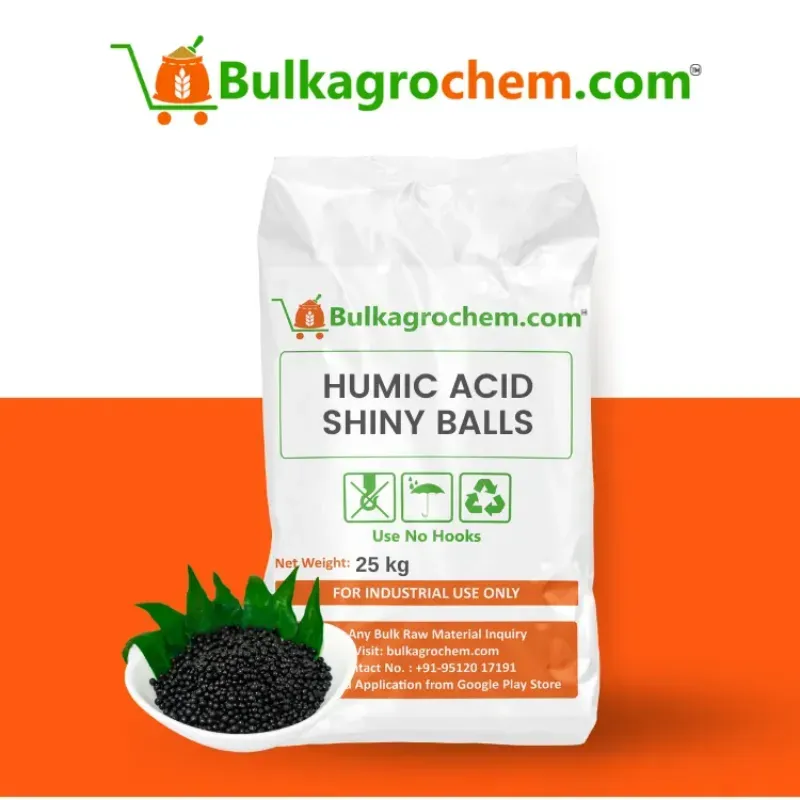
about 18 kg Sulphur 90%
+2%
seed oil content
up to, with basal S
+25%
seed yield
up to, with basal S
Source: ICAR-DRMR, Bharatpur and published Indian mustard researchBulkAgroChem.com
Why Mustard Needs More Sulphur Than Most Crops
Mustard belongs to the crucifer family, which uses far more sulphur than cereals. Sulphur builds the oil, protein and pungent compounds in the seed, so a shortage shows up directly in yield and oil recovery.
What sulphur does inside the mustard plant
Sulphur is often called the fourth major nutrient after N, P and K, and in oilseeds it truly earns that place. Without it, the plant keeps growing but cannot fill its seeds properly.
✓Forms cysteine and methionine, the building blocks of seed protein.
✓Needed for chlorophyll, so deficient leaves turn pale.
✓Drives oil synthesis; 40 kg S/ha can add up to 2% oil (ICAR-DRMR).
✓Raises seed yield by up to 25% when applied at sowing.
✓Helps the plant use applied nitrogen efficiently.
Why sulphur deficiency is spreading in Indian soils
Earlier, sulphur reached fields by accident through single super phosphate and farmyard manure. Today most farmers use DAP and urea, which carry no sulphur at all.
!DAP and urea supply zero sulphur.
!Intensive cropping removes more sulphur every season.
!Far less FYM goes back into the soil.
!Light, low-organic-matter soils run short first.
!Canal-irrigated fields often show the gap early.
Signs of Sulphur Deficiency in Mustard
Sulphur does not move easily inside the plant, so the shortage appears first on the youngest leaves. Symptoms become clear between the rosette and bolting stages, when demand peaks.
Symptoms on leaves, flowers and pods
Look at the top of the plant first. A sulphur-starved crop looks thin and pale from above, even when the lower canopy is still green.
!Young leaves turn pale yellow; older leaves stay green.
!Leaves become narrow and cupped, like a spoon.
!A purple tinge may show on the leaf underside.
!Flowers are small, pale and delayed.
!Pods fill poorly and seeds are small and low in oil.
Sulphur vs nitrogen deficiency: how to tell them apart
Both deficiencies make the crop yellow, which is why they are often confused. The quickest check is where the yellowing starts on the plant.
✓Sulphur: yellowing starts at the top, on new leaves.
✓Nitrogen: yellowing starts at the bottom, on old leaves.
✓Sulphur-deficient leaves cup inward; nitrogen-deficient ones do not.
✓Urea will not fix a sulphur problem.
✓A soil test for available S gives the final answer.
Field diagnosis
Sulphur vs Nitrogen Deficiency in Mustard
Both turn the crop yellow. Where the yellowing starts tells you which one it is.
▲ Sulphur deficiency
Leaves hit first
Young, upper leaves
Leaf colour
Pale yellow, veins slightly greener
Leaf shape
Narrow, cupped, purple underside
Flowers
Small, pale, delayed
Pods and seed
Poor fill, shrivelled seed, low oil
Quick fix
Sulphate source or foliar sulphur
▼ Nitrogen deficiency
Leaves hit first
Old, lower leaves
Leaf colour
Uniform yellow, lower leaves dry
Leaf shape
Normal shape, just smaller
Flowers
Fewer flowers
Pods and seed
Fewer pods, lower yield
Quick fix
Urea top dressing
Confirm with a soil test for available sulphurBulkAgroChem.com
Best Sulphur Fertilizer Sources for Mustard
Plants absorb sulphur only as sulphate. Some fertilizers supply sulphate directly and act fast, while elemental sulphur is converted by soil bacteria over a few weeks and feeds the crop steadily.
Source comparison
Sulphur Sources for Mustard Compared
Sulphur content, release speed and quantity needed to supply 16 kg S per acre (40 kg S/ha)
BEST FOR LARGE AREAS
Sulphur 90% (WDG / bentonite)
90%sulphur
Steady release+ None
Needed per acre~18 kg
Elemental sulphur
85%sulphur
Slow release+ None
Needed per acre~19 kg
Ammonium sulphate
24%sulphur
Fast release+ Nitrogen
Needed per acre~67 kg
Pyrite
22%sulphur
Slow release+ Iron
Needed per acre~73 kg
Gypsum
18%sulphur
Moderate release+ Calcium
Needed per acre~90 kg
Potassium sulphate (SOP)
18%sulphur
Fast release+ Potash
Needed per acre~90 kg
Single super phosphate
12%sulphur
Fast release+ Phosphorus, calcium
Needed per acre~135 kg
Source: ICAR-DRMR, Bharatpur and published Indian mustard researchBulkAgroChem.com
Why Sulphur 90% is the most practical choice
The biggest advantage of a 90% sulphur product is concentration. You handle about one-fifth of the quantity needed with gypsum to deliver the same sulphur.
✓About 18 kg per acre covers the full 40 kg S/ha dose.
✓Less to buy, transport, store and spread.
✓Fine WDG granules oxidise steadily in moist soil.
✓The same product works for foliar sprays at bolting.
✓Suits neutral to alkaline soils well.
When gypsum, SSP or ammonium sulphate makes more sense
Elemental sulphur is not the answer for every field. Late sowing, sodic soils or a need for other nutrients can make a sulphate source the better pick.
✓SSP instead of DAP adds sulphur and calcium with phosphorus.
✓Gypsum improves sodic soils while supplying sulphur.
✓Ammonium sulphate gives a quick, ready-to-use correction.
✓Potassium sulphate (NPK 00-00-50) suits fertigated fields.
✓Late-sown crops respond faster to sulphate sources.
Sulphur Dose for Mustard per Acre
ICAR-DRMR recommends 40 kg of sulphur per hectare, about 16 kg per acre. A soil test lets you fine-tune this: deficient fields need the full dose, rich fields only a maintenance dose.
Dose calculator
Sulphur Dose for Mustard per Acre
Match the dose to your soil test and pick the product quantity
LOW
Available S below 10 mg/kg
16 kg
sulphur per acre (40 kg/ha)
Sulphur 90%
~18 kg
or Gypsum
~90 kg
➜ Full dose, no shortcuts
MEDIUM
Available S 10 to 20 mg/kg
8 to 12 kg
sulphur per acre (20 to 30 kg/ha)
Sulphur 90%
9 to 13 kg
or Gypsum
45 to 67 kg
➜ Moderate dose protects oil
HIGH
Available S above 20 mg/kg
4 kg
sulphur per acre (10 kg/ha)
Sulphur 90%
~4.5 kg
or Gypsum
~22 kg
➜ Maintenance dose only
NO SOIL TEST
Status unknown
16 kg
sulphur per acre (40 kg/ha)
Sulphur 90%
~18 kg
or Gypsum
~90 kg
➜ Use the ICAR-DRMR dose
Source: ICAR-DRMR, Bharatpur and published Indian mustard researchBulkAgroChem.com
How to read your soil test report
Most Indian soil labs report available sulphur in mg/kg (ppm), usually using a calcium chloride extract. Around 10 mg/kg is treated as the critical level.
✓Find "Available S" on your Soil Health Card or lab report.
✓Below 10 mg/kg: apply the full dose.
✓10 to 20 mg/kg: a moderate dose protects yield and oil.
✓Above 20 mg/kg: a small maintenance dose is enough.
✓Re-test every two to three seasons.
Adjust the dose if you already use SSP or gypsum
Some basal fertilizers already carry sulphur. Count it before adding more, or you will overspend on the same nutrient.
✓One 50 kg bag of SSP adds about 6 kg sulphur.
✓One 50 kg bag of gypsum adds about 9 kg sulphur.
✓One 50 kg bag of ammonium sulphate adds about 12 kg sulphur.
✓Subtract this from your 16 kg per acre target.
✓Make up the balance with Sulphur 90%.
When to Apply Sulphur in Mustard
Timing matters as much as the dose. Sulphur applied at sowing gives the best result, application at bolting still recovers much of the loss, and by flowering it can only partly close the gap.
Application timing
Sulphur Application Schedule for Mustard
The earlier the sulphur goes in, the more yield and oil it protects (DAS = days after sowing)
1
0 DAS
Sowing
Full basal dose of Sulphur 90% or gypsum, mixed into the top 10 to 15 cm of soil
Best response
2
25 to 35 DAS
Rosette stage
At first irrigation, top up with a sulphate source if basal sulphur was missed
Fast correction
3
35 to 45 DAS
Bolting
Foliar spray of Sulphur 90% WDG at 2 g per litre (0.2%)
Recovers most of the loss
4
45 to 60 DAS
Flowering
Spray only if deficiency or powdery mildew appears
Partial recovery only
Source: ICAR-DRMR, Bharatpur and published Indian mustard researchBulkAgroChem.com
Basal application at sowing: the best time
Elemental sulphur needs two to four weeks in moist soil to turn into sulphate. Applying it at the last ploughing means it is ready when the crop starts growing fast.
✓Mix Sulphur 90% with basal NPK or well-rotted FYM.
✓Broadcast before the final ploughing.
✓Work it into the top 10 to 15 cm of soil.
✓Ensure good soil moisture for oxidation.
✓Never leave it lying on the surface.
Foliar spray with Sulphur 90% WDG
If the basal dose was missed or upper leaves look pale and cupped, a foliar spray is the fastest rescue. It also helps against powdery mildew late in the season.
✓Dose: 2 g per litre of water (0.2%).
✓About 400 g in 200 litres of water per acre.
✓Spray in the morning or late afternoon.
✓Avoid spraying above 32°C to prevent leaf burn.
✓Repeat after 10 to 15 days on badly deficient fields.
Common Mistakes That Waste Sulphur
Most of the money farmers lose on sulphur goes on timing and handling, not on the product. Avoid these mistakes, and pair your plan with Trichoderma seed treatment for a strong rabi start.
✕Using elemental sulphur as a late top dressing.
✕Treating yellow upper leaves with more urea.
✕Skipping sulphur because SSP was used two seasons ago.
✕Spraying sulphur in hot afternoons.
✕Applying sulphur on dry soil and waiting for rain.
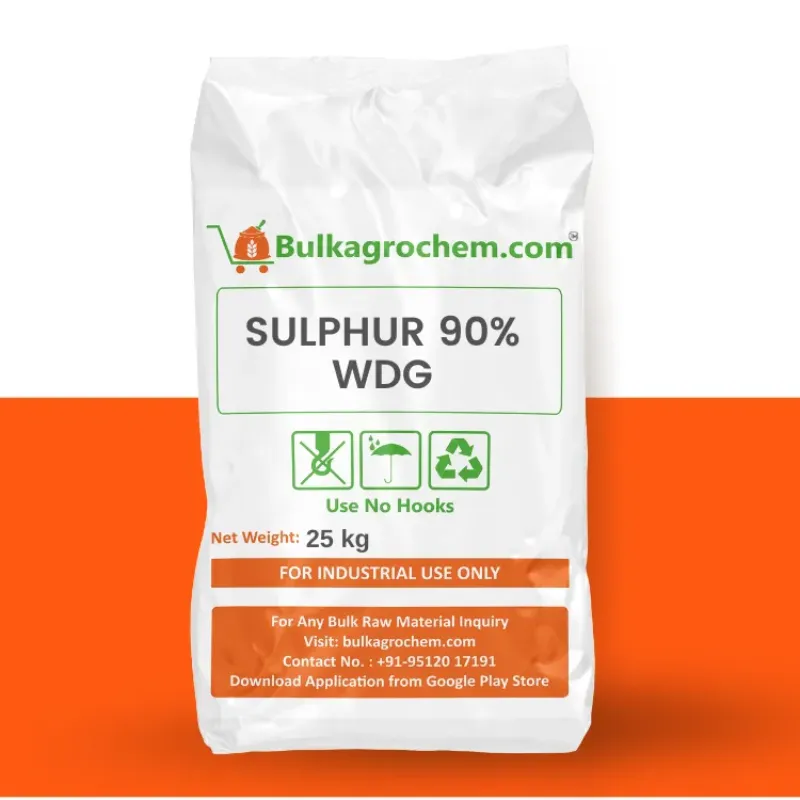
Buy Sulphur 90% WDG in Bulk from BulkAgroChem
BulkAgroChem supplies Sulphur 90% WDG in bulk to dealers, distributors and large farmers across India, with pricing that drops as your order grows.
BULK SUPPLY FOR DEALERS AND FARMERS
Sulphur 90% WDG from BulkAgroChem
High-purity sulphur for basal, drip and foliar use in mustard, wheat, onion, garlic, pulses, fruits and vegetables. Tiered bulk pricing from 25 units, pan-India dispatch.
Check price and orderGet bulk quote on WhatsApp
Frequently Asked Questions
Quick answers to the questions farmers and dealers ask most about sulphur for mustard.
How much sulphur does mustard need per acre?
ICAR-DRMR recommends 40 kg S per hectare, about 16 kg of sulphur per acre. That equals roughly 18 kg of Sulphur 90% or about 90 kg of gypsum. Fields with medium or high soil sulphur need less.
Which is the best sulphur fertilizer for mustard?
For basal use over large areas, a 90% sulphur product is the most practical because you handle far less material. Gypsum suits sodic soils, SSP suits fields that also need phosphorus, and ammonium sulphate suits quick corrections.
When should sulphur be applied in mustard?
Before or at sowing, mixed into the soil. If that was missed, apply a sulphate source by the first irrigation or spray sulphur at bolting. Application at flowering gives only partial recovery.
Does sulphur increase oil content in mustard?
Yes. According to ICAR-DRMR, basal application of 40 kg S/ha can raise seed oil content by up to 2% and seed yield by up to 25%.
Can I spray Sulphur 90% WDG on mustard?
Yes. A 0.2% spray (2 g per litre) at bolting corrects deficiency and also helps against powdery mildew. Spray in cooler hours and avoid temperatures above 32°C.
How do I know if my mustard crop is sulphur deficient?
Pale, narrow, cupped young leaves at the top while lower leaves stay green point to sulphur deficiency. Nitrogen deficiency shows the reverse pattern, starting from the lower leaves.
Can too much sulphur harm mustard?
At recommended doses, no. Very heavy doses of elemental sulphur can lower soil pH over time, which matters mainly on acidic soils. Stick to soil-test-based rates.
Conclusion
Mustard pays you for its oil, and oil needs sulphur. A soil test, a basal dose of about 16 kg sulphur per acre on deficient fields and a quick foliar rescue at bolting can lift both yield and oil without a big jump in cost. Plan your sulphur before sowing, and order Sulphur 90% WDG and other rabi inputs from the BulkAgroChem shop.