Every rabi season, a lot of farmers lose plants before the crop has even properly started. Gram seedlings wilt in patches, wheat comes up uneven, and mustard shows collar rot in the first few weeks. Most of this damage begins in the soil, right around the seed. Trichoderma seed treatment is one of the cheapest and simplest ways to stop it. It costs a few rupees per kilo of seed, takes about half an hour, and gives the young root a living shield against soil-borne fungi.
This guide explains what Trichoderma does, the right dose per kg seed for major rabi crops, the exact treatment method, how to enrich FYM for soil application, and the mistakes that quietly kill the fungus before it reaches the field.
What Is Trichoderma and Why Rabi Seeds Need It
Trichoderma is a beneficial fungus that lives in healthy soil. When it is coated on seed, it grows along with the new roots and crowds out disease-causing fungi. For rabi crops sown into cool, moist soil, that early protection matters most.
How Trichoderma Protects the Seed
Once the seed is sown, Trichoderma spores wake up with the soil moisture and start colonising the root surface. It takes up the space and food that harmful fungi need, and it can attack them directly.
- Competes with pathogens for space and nutrients around the root.
- Releases enzymes that break down the cell walls of harmful fungi.
- Triggers the plant's own defence response.
- Supports stronger early root growth and better germination.
- Leaves no chemical residue, so it suits organic and export crops.
Diseases It Helps Prevent in Rabi Crops
Trichoderma works against soil-borne and seed-borne fungal problems. It is a preventive tool, so it gives the best results when applied before the disease shows up.
- Wilt and dry root rot in gram (chickpea) and lentil.
- Seed rot and damping off in wheat, mustard and vegetable nurseries.
- Collar rot and stem rot in pulses and oilseeds.
- Root rot in pea, cumin, coriander and other seed spices.
- Early seedling death caused by Fusarium, Rhizoctonia, Pythium and Sclerotium.
Trichoderma Dose per Kg Seed for Major Rabi Crops
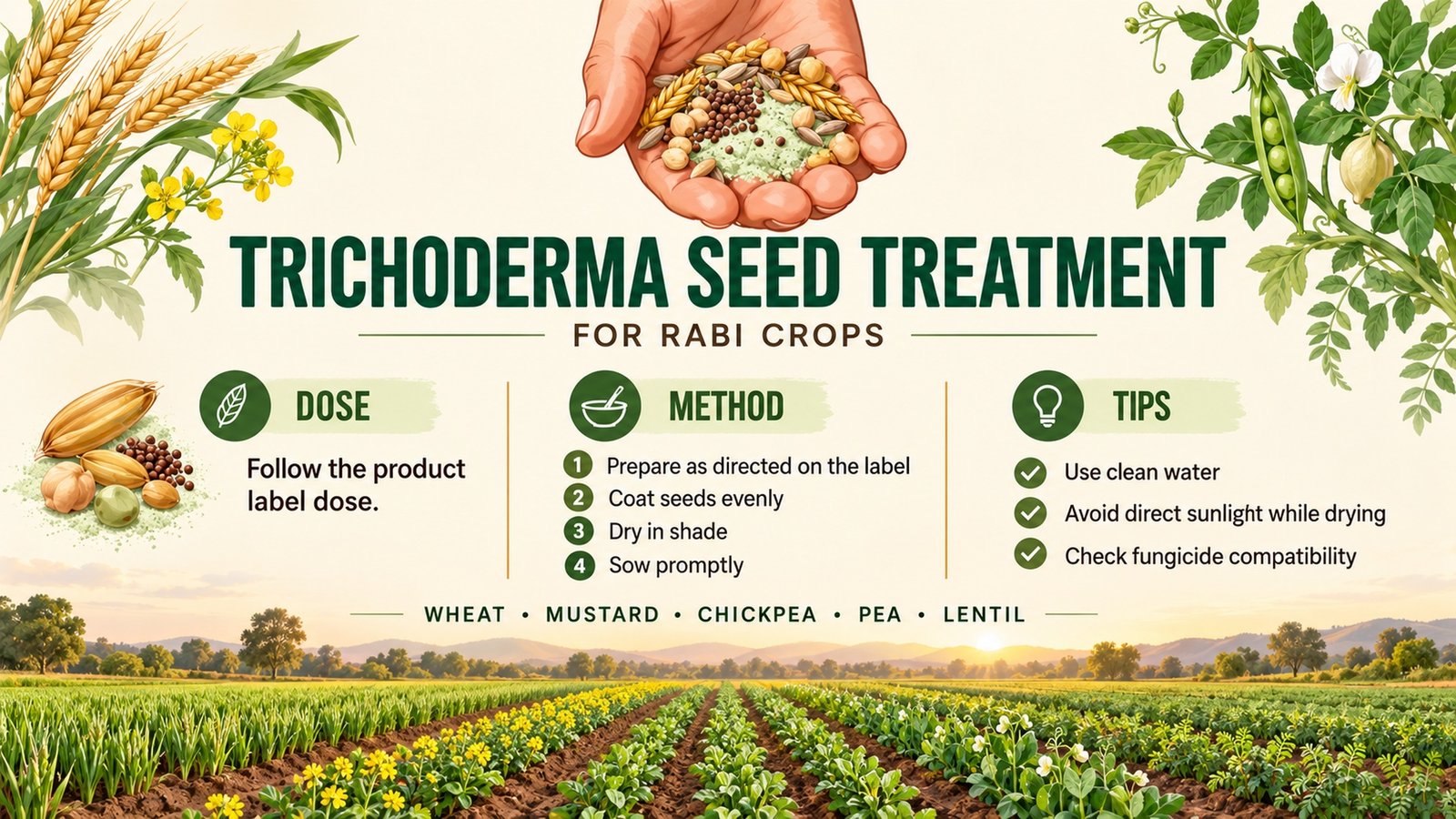
For a standard powder formulation, most extension advisories recommend 4 to 10 grams of Trichoderma per kg of seed. Smaller seeds have more surface area per kilo, so they usually need the higher end of the range.

| Note: These are general ranges. Spore count (CFU) differs between products, so always check the label of the pack you are using. |
Why the Dose Changes With Seed Size and Formulation
The goal is a thin, even coat on every seed. A kilo of mustard has far more seeds than a kilo of gram, so it needs more powder to cover all of them.
- Bold seeds like gram and wheat: lower end of the range.
- Small seeds like mustard and cumin: higher end of the range.
- Higher CFU products: less powder needed per kg.
- Old or badly stored powder: lower live spores, weaker results.
Step-by-Step Trichoderma Seed Treatment Method
Seed treatment is simple enough to do at home or at the farm. The key is gentle mixing, shade drying, and sowing on the same day.
What You Need Before You Start
Keep everything ready before opening the pack, because the coated seed should not sit around for long.
- Clean seed, free of broken grains and dust.
- Trichoderma powder as per the dose table.
- A little water with jaggery (about 50 g jaggery in 500 ml water) as a sticker.
- A clean drum, bucket or plastic sheet for mixing.
- A shaded spot for drying.
The Treatment Steps
Follow these steps in order. The whole process takes about 20 to 30 minutes for a normal seed lot.
- Spread the seed on a plastic sheet or put it in a drum.
- Sprinkle just enough jaggery water to make the seed slightly damp, not wet.
- Add the measured Trichoderma powder over the seed.
- Mix gently by hand (wear gloves) or rotate the drum until every seed has a light coat.
- Spread the seed in the shade for 20 to 30 minutes to dry.
- Sow the treated seed the same day, ideally within a few hours.
Trichoderma Soil Application with FYM
Seed treatment protects the seed. Soil application builds a Trichoderma population across the field. Using both together gives the most reliable protection, especially in fields with a history of wilt.
How to Enrich FYM With Trichoderma
Trichoderma multiplies well on organic matter. Mixing it with well-rotted farmyard manure a week or so before use increases the number of active spores going into the soil.
- Take about 50 to 100 kg of well-decomposed FYM or vermicompost for one acre.
- Mix 1 to 2.5 kg Trichoderma powder evenly into it (follow the label dose).
- Sprinkle water to keep the heap moist, not soggy.
- Cover with a gunny bag and keep it in the shade for 7 to 10 days.
- Turn the heap once in between; a white-green fungal growth shows it is ready.
When to Apply It in the Field
Timing and soil moisture decide how well the fungus settles in. Dry, hot soil or direct sun can kill a large share of the spores.
- Broadcast the enriched FYM before the last ploughing or at sowing.
- Apply only when the soil has good moisture.
- Prefer evening hours over hot afternoons.
- Mix it into the top layer of soil instead of leaving it on the surface.
Using Trichoderma With Other Seed Treatments
Trichoderma is a living organism, so it gets along with some inputs and not with others. Planning the combination correctly protects your investment in both products.
Compatible Partners: Rhizobium, PSB and Mycorrhiza
Biofertilizers work alongside Trichoderma very well. For pulses, a combination of Trichoderma, Rhizobium and PSB gives both disease protection and better nutrient uptake from the same seed treatment.
- Rhizobium for gram, lentil and pea to improve nodulation.
- PSB to make soil phosphorus more available to the crop.
- KMB (potash mobilising bacteria) for potash uptake.
- Mycorrhiza for a larger root absorption zone.
- Apply Trichoderma first, let it dry, then coat the biofertilizer.
Chemicals to Keep Away
Many chemical fungicides kill Trichoderma along with the harmful fungi. If a chemical seed dressing is unavoidable, treat separately and keep a gap instead of mixing both on the same seed at the same time.
- Do not mix Trichoderma directly with chemical fungicides such as carbendazim.
- Avoid copper-based and mercury-based products on Trichoderma-treated seed.
- Keep a gap of 7 to 15 days between soil drenching with chemical fungicides and Trichoderma.
- Check the label or ask your supplier before combining with any insecticide.
Common Mistakes That Waste Trichoderma
Most complaints that "Trichoderma did not work" trace back to handling mistakes, not the product. A few simple habits make a big difference.
Handling and Storage Errors
Trichoderma spores are alive. Heat, sunlight and time reduce their numbers, so storage matters as much as dose.
- Drying treated seed in direct sunlight.
- Storing packs in hot godowns or near fertilizer bags.
- Using powder after its expiry date.
- Keeping treated seed for several days before sowing.
- Applying on dry soil with no irrigation planned.
Buying Trichoderma in Bulk for Dealers and Large Farms
Rabi demand for Trichoderma peaks in October and November, and short supply during sowing is a common problem for dealers. Stocking early at bulk rates protects margins and keeps customers from switching shops.
Why Source From BulkAgroChem
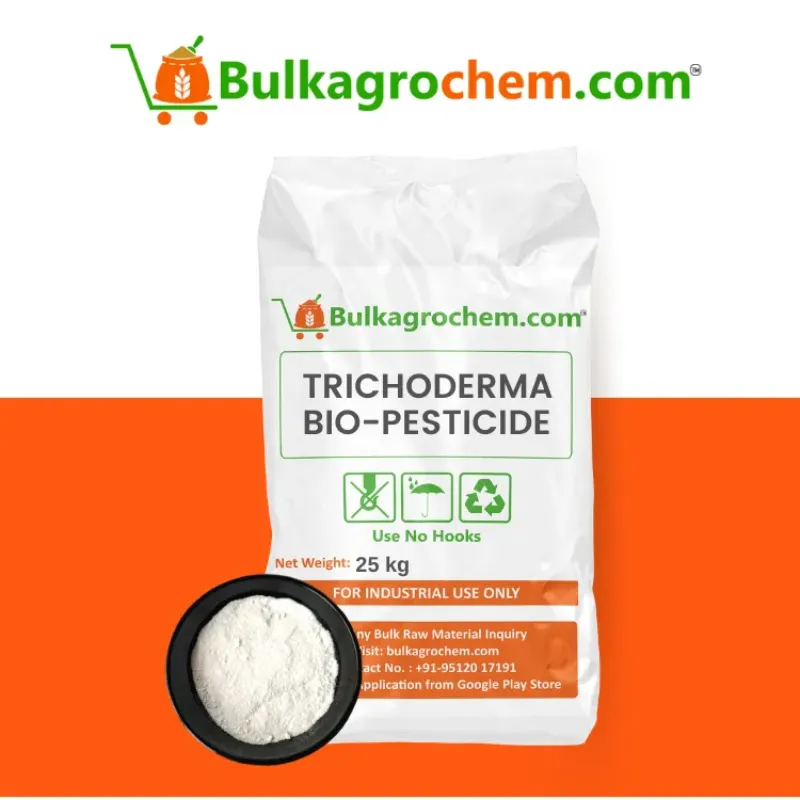
BulkAgroChem supplies Trichoderma bio-pesticide powder along with the biofertilizers that pair with it, so dealers and large farmers can source a complete seed treatment kit from one place.
- Trichoderma Bio-Pesticide Powder (water insoluble) in bulk packing.
- PSB Liquid Bio-Fertilizer, KMB and Mycorrhiza for combined seed treatment.
- Humic Acid 70% powder to support root growth after germination.
- Bulk pricing and availability updates shared directly on WhatsApp.
- Delivery across India for dealers, FPOs and large growers.
Planning your rabi stock? Visit BulkAgroChem.com and share your number to get bulk pricing for Trichoderma and biofertilizers before the sowing rush.
Frequently Asked Questions
How much Trichoderma is needed per kg of seed?
Most powder formulations are used at 4 to 10 grams per kg of seed. Bold seeds like wheat and gram need the lower end, while small seeds like mustard and cumin need the higher end. Always follow the product label.
Can I treat seed with Trichoderma and Rhizobium together?
Yes. Coat the seed with Trichoderma first, let it dry for a few minutes in the shade, and then apply Rhizobium or PSB. Both are biological inputs and work well together.
How long can Trichoderma-treated seed be kept before sowing?
It is best to sow on the same day, within a few hours of treatment. Keeping treated seed for days, especially in heat, reduces the number of live spores.
Can Trichoderma be mixed with carbendazim?
No. Carbendazim and many other chemical fungicides can kill Trichoderma. If you must use a chemical fungicide, apply it separately and keep a gap between the two.
Is Trichoderma useful for gram wilt?
Yes. Trichoderma seed treatment is widely recommended for reducing wilt and dry root rot in gram. Combining it with enriched FYM in the soil gives better results in fields that had wilt earlier.
Is Trichoderma safe for organic farming?
Yes. It is a natural soil fungus, leaves no chemical residue and is widely used in organic and natural farming systems.
Conclusion
A good rabi crop starts with a healthy seedling, and a healthy seedling starts with a protected seed. Trichoderma seed treatment costs very little, is easy to do, and pays back through better germination and fewer wilt patches. Use the right dose, dry the seed in the shade, sow the same day, and support it with enriched FYM in the soil. Do this every season, and the soil itself becomes more resistant over time.