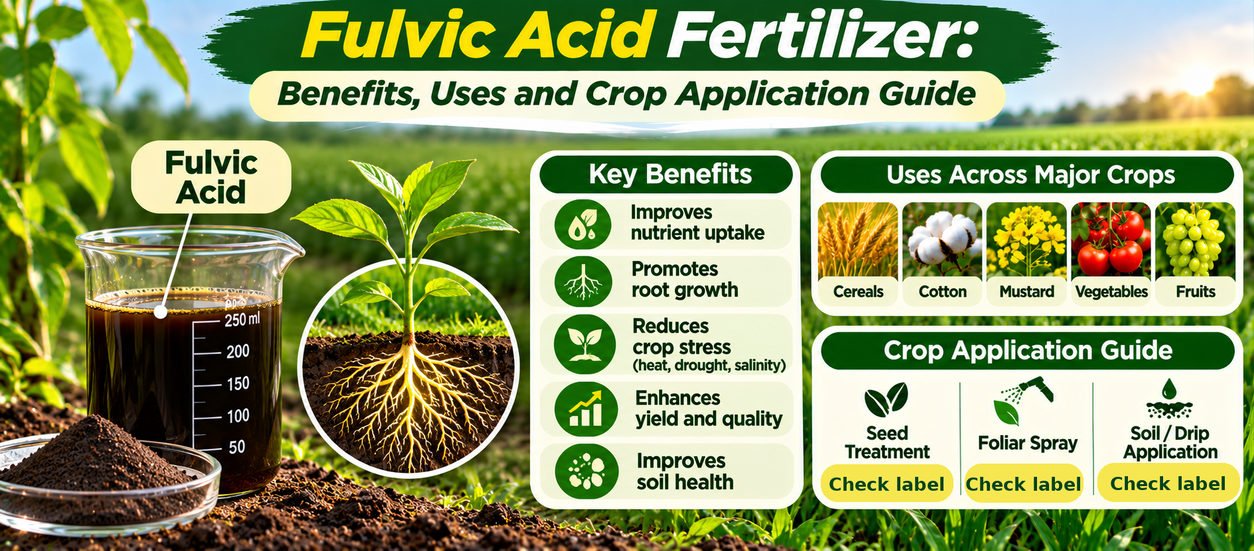
Fulvic Acid Fertilizer: Benefits, Uses and Crop Application Guide
Fulvic acid fertilizer is widely used in modern crop nutrition programs because of its high solubility and its ability to interact with nutrients in the root zone and in foliar applications. Fulvic acid belongs to the humic-substance family, but compared with humic acid it generally has a lower molecular size and remains soluble across a wider pH range.
For growers, the key point is that fulvic acid is not a replacement for NPK fertilizer. Its role is to support nutrient movement, root activity and nutrient-use efficiency when used alongside a complete crop nutrition plan. This guide explains how fulvic acid works, where it fits best, how it differs from humic acid, and how to use it in soil, fertigation and foliar programs.
What Is Fulvic Acid Fertilizer?
Fulvic acid is a soluble fraction of humic substances formed through the decomposition and transformation of organic matter. Commercial agricultural products may be produced from mineral humic sources such as leonardite or from plant-based and biochemical sources.
Because fulvic acid is highly soluble, it is commonly used in liquid fertilizers, micronutrient blends, drip irrigation and foliar sprays. Product quality can vary, so buyers should compare actual fulvic acid content, source, solubility, pH and formulation before selecting a product.
How Fulvic Acid Works in Crop Nutrition
Fulvic acid can interact with mineral nutrients and the plant root environment in several ways. Its smaller molecular size and high solubility make it especially useful where nutrient mobility and solution compatibility are important.
Supports nutrient transport
Fulvic compounds can interact with metal ions and micronutrients such as iron, zinc and manganese. This can help keep nutrients in soluble or plant-available forms under suitable conditions.
Supports root-zone nutrient efficiency
When used in fertigation or soil programs, fulvic acid can complement mineral fertilizers by supporting nutrient availability around active roots.
Supports plant physiological activity
Research on fulvic substances has reported positive effects on root growth, nutrient uptake and crop response in a range of species, although the degree of response varies with crop, dose, soil and environmental conditions.
Benefits of Fulvic Acid Fertilizer
When used correctly, fulvic acid can provide several practical advantages in integrated crop nutrition programs.
- Supports nutrient uptake: may help maintain micronutrients and other nutrients in forms that are easier for plants to access.
- Supports root growth: fulvic substances are often included in programs designed to encourage active root development.
- Works well in soluble systems: high solubility makes fulvic acid useful in fertigation, liquid fertilizer and foliar applications.
- Complements micronutrients: commonly used with iron, zinc, manganese and other trace elements.
- Supports crop resilience: fulvic substances are often used as part of programs aimed at supporting plant response under environmental stress.
- Fits multiple growth stages: can be used during establishment, vegetative growth and reproductive stages when the formulation and crop program support it.
Fulvic Acid vs. Humic Acid
Fulvic acid and humic acid come from the same broad family of humic substances, but they are not identical. Their different chemical behavior affects where each is most useful.
| Feature Fulvic Acid Humic Acid | ||
| Relative molecular size | Generally lower | Generally higher |
| Water solubility | High across a wider pH range | More dependent on pH and formulation |
| Common use | Foliar, fertigation, liquid fertilizer, micronutrient blends | Soil conditioning, root-zone support, granular and liquid programs |
| Main strength | Nutrient mobility and soluble applications | Soil interaction and conditioning |
Growers do not necessarily need to choose one over the other. Many crop programs use humic acid for soil-focused benefits and fulvic acid where solubility and nutrient transport are more important.
For a deeper soil-focused comparison, read Bulkagrochem's guide to humic acid fertilizer.
When Is Fulvic Acid Most Useful?
Fulvic acid is especially useful in programs where fertilizers need to remain soluble and move efficiently through irrigation water, spray solutions or the root zone.
During early root establishment
Young crops rely heavily on active root growth. Fulvic acid is often included with starter fertilizers or micronutrients to support root-zone nutrition.
During intensive fertigation
In drip-irrigated crops, fulvic acid can be added to compatible fertilizer programs to support nutrient delivery through the wetted root zone.
During foliar nutrient programs
Because fulvic acid is highly soluble, it is commonly included in foliar formulations where nutrient movement and solution stability are important.
How to Use Fulvic Acid in Fertigation
Fertigation is one of the most practical uses for fulvic acid because suitable formulations dissolve easily in irrigation water and can be delivered close to active roots.
Good fertigation practice includes:
- Use a fully soluble formulation designed for irrigation systems.
- Check compatibility with the fertilizers already in the stock tank.
- Use clean water and maintain proper filtration.
- Follow the product rate rather than assuming more is better.
- Apply during periods of active root growth where possible.
- Flush irrigation lines as required by the system.
Foliar Application of Fulvic Acid
Fulvic acid is frequently used in foliar feeding programs because of its solubility and compatibility with many nutrient formulations. It may be applied alone or with compatible micronutrients and fertilizers when allowed by the product label.
For foliar use:
- Use the concentration recommended for the specific product and crop.
- Spray during cooler parts of the day.
- Avoid severely stressed or wilted crops unless the label specifically recommends treatment.
- Check water pH and quality where relevant.
- Perform a jar test before combining fulvic acid with unfamiliar products.
Fulvic Acid with Micronutrients
One of the most common uses of fulvic acid is in micronutrient programs. Fulvic compounds can interact with micronutrients such as iron, zinc, manganese and copper, helping maintain them in solution under suitable conditions.
This makes fulvic acid useful in specialty fertilizer blends and foliar products. However, it should not be treated as a substitute for an actual micronutrient source. If a crop is zinc-deficient, for example, zinc still needs to be supplied in an appropriate form and amount.
Bulkagrochem also offers information on chelated micronutrients in agriculture for growers comparing micronutrient strategies.
Fulvic Acid and Crop Stress Management
Fulvic acid is often marketed as a biostimulant-type input for crops experiencing heat, drought, salinity or transplanting stress. Research has reported positive responses in some crops, but results are not guaranteed and depend strongly on growing conditions.
Fulvic acid should therefore be used as a supporting input, not as a replacement for irrigation management, drainage, salinity control, disease management or balanced fertilization.
Can Fulvic Acid Be Used in Soil?
Yes. Fulvic acid can be applied to soil or through irrigation water. In soil programs, its main value is often linked to nutrient interaction and root-zone availability rather than long-term soil-conditioning effects.
Where the primary goal is improving soil structure, aggregation or long-term organic matter management, humic acid or other soil conditioners may be more suitable. Where the priority is high solubility and nutrient movement, fulvic acid can be a stronger fit.
Common Mistakes to Avoid
Treating fulvic acid as a complete fertilizer
Fulvic acid does not supply enough nitrogen, phosphorus, potassium or micronutrients to replace a complete fertilizer program.
Using excessive rates
Higher concentration does not automatically improve results. Follow the product label and crop recommendation.
Ignoring compatibility
Fulvic acid is broadly compatible with many fertilizer systems, but not every tank mix is safe or stable. Always verify compatibility.
Expecting it to solve severe soil problems
Compaction, poor drainage, severe salinity or nutrient imbalance still require direct agronomic correction.
How to Choose a Fulvic Acid Product
Commercial fulvic products can differ significantly. Before buying, compare:
- Fulvic acid content: confirm the guaranteed concentration.
- Source: mineral, leonardite-based, plant-based or biochemical.
- Solubility: especially important for foliar and drip irrigation.
- pH: relevant when blending with other fertilizers.
- Formulation: powder, liquid or potassium fulvate.
- Application method: soil, foliar, fertigation or formulation use.
Fulvic Acid and Crop Nutrition from Bulkagrochem
Bulkagrochem supplies agricultural inputs for growers, distributors, formulators and bulk buyers. Fulvic acid can be integrated with fertilizers, micronutrients and other crop-nutrition products depending on the crop program and application method.
Explore the Bulkagrochem fertilizer range for complementary crop nutrition products. For current availability, bulk purchasing or formulation enquiries, use the Bulkagrochem contact page.
Best Practices for Better Results
- Define the objective first. Decide whether the goal is nutrient transport, fertigation support, micronutrient delivery or root-zone activity.
- Select the right formulation. Use highly soluble grades for foliar and drip systems.
- Follow the product rate. Do not assume stronger concentration gives better results.
- Combine with balanced nutrition. Fulvic acid supports nutrient use but does not replace fertilizers.
- Check tank-mix compatibility. Especially when combining with concentrated nutrients or crop-protection products.
- Track crop response. Monitor root activity, crop vigor, nutrient status and field performance.
Frequently Asked Questions
1. What is fulvic acid fertilizer used for?
It is used to support nutrient mobility, root activity and nutrient uptake, especially in foliar, fertigation and liquid fertilizer programs.
2. Is fulvic acid a fertilizer?
Fulvic acid is better considered a humic-substance or biostimulant-type input. It supports crop nutrition but does not replace essential fertilizer nutrients.
3. Can fulvic acid be used in drip irrigation?
Yes. Fully soluble fulvic acid formulations are commonly used in fertigation and drip irrigation systems.
4. Can fulvic acid be sprayed on leaves?
Yes. Fulvic acid is widely used in foliar formulations because of its high solubility. Always follow the specific product label and crop rate.
5. What is the difference between fulvic acid and humic acid?
Fulvic acid generally has a lower molecular size and higher solubility, making it more suitable for foliar and liquid systems. Humic acid is more commonly used for soil conditioning and root-zone support.
6. Can fulvic acid be mixed with micronutrients?
It is commonly used with micronutrients such as iron, zinc and manganese, but compatibility should still be checked for each formulation.
7. Can fulvic acid replace NPK fertilizer?
No. Fulvic acid may improve nutrient-use efficiency, but crops still require adequate nitrogen, phosphorus, potassium and other essential nutrients.
Conclusion
Fulvic acid fertilizer is a versatile crop-nutrition support input that is particularly useful in fertigation, foliar and micronutrient programs. Its high solubility and ability to interact with nutrients make it a useful complement to conventional fertilizers.
The best results come from using fulvic acid for the right objective, selecting the correct formulation, checking compatibility and combining it with a balanced fertilizer program.
Need fulvic acid or related agricultural inputs in bulk? Contact Bulkagrochem for current availability, bulk supply and purchasing support.