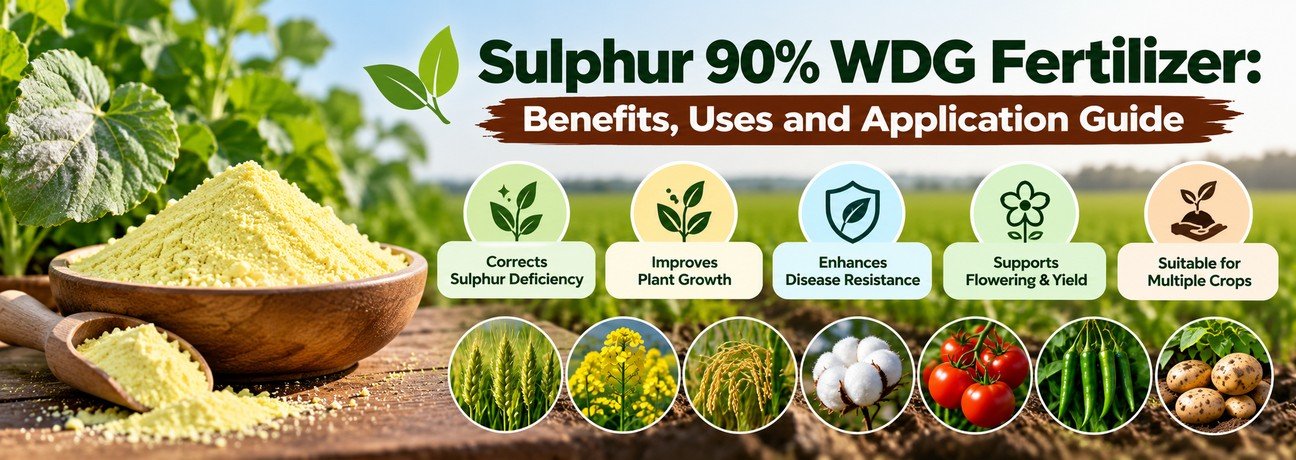
Sulphur 90% WDG Fertilizer: Benefits, Uses and Application Guide
Sulphur 90% WDG fertilizer is a concentrated sulphur source used to correct sulphur deficiency and support crop nutrition. Sulphur is an essential secondary nutrient involved in amino-acid formation, protein synthesis, enzyme activity and chlorophyll-related plant processes. Crops such as oilseeds, pulses, cereals, vegetables and many horticultural crops can respond when soil sulphur is inadequate.
This guide explains what Sulphur 90% WDG is, how sulphur functions in plants, where the product fits into crop nutrition, common deficiency symptoms, soil and foliar application considerations, and practical precautions for better results.
What Is Sulphur 90% WDG?
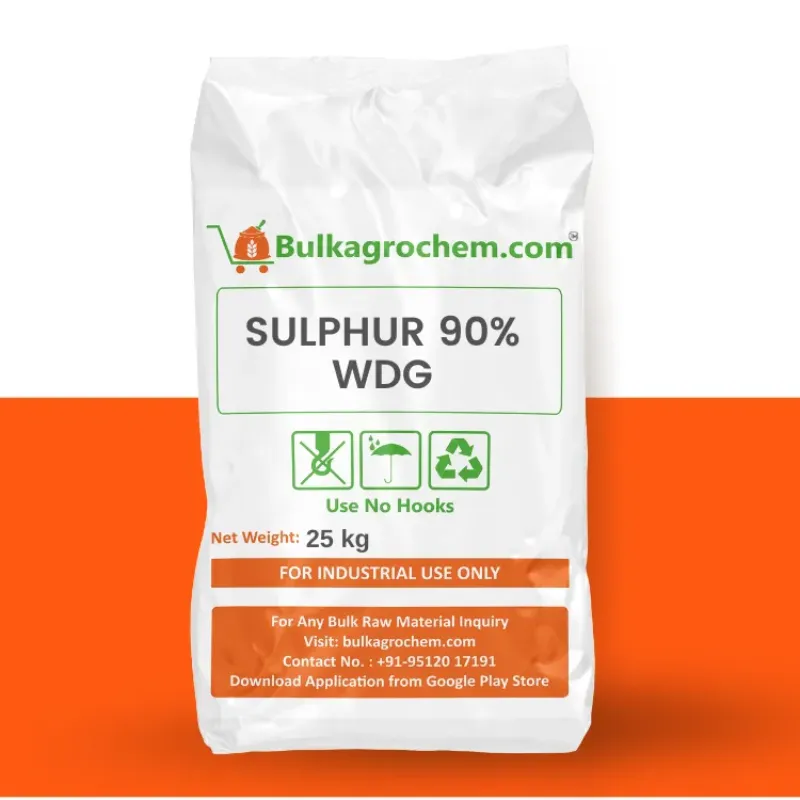
Sulphur 90% WDG is a water-dispersible granule formulation containing a high concentration of elemental sulphur. The WDG format is designed to disperse in water more conveniently than raw sulphur powder, making handling and application easier in suitable agricultural programs.
Bulkagrochem currently lists its Sulphur 90% WDG as a white, water-soluble agricultural fertilizer product intended for a wide range of crops. The current product guidance lists both soil and foliar application options.
Why Sulphur Matters in Plant Nutrition
Sulphur is required in smaller quantities than nitrogen, phosphorus and potassium, but it remains essential for normal plant growth. A crop with inadequate sulphur may be unable to use nitrogen efficiently or form proteins properly.
Supports amino-acid and protein formation
Sulphur is a component of sulphur-containing amino acids such as cysteine and methionine. These amino acids are important building blocks for plant proteins and enzymes.
Supports chlorophyll-related growth
Although sulphur is not a structural part of chlorophyll, adequate sulphur nutrition supports metabolic processes associated with healthy green growth. Severe sulphur deficiency can result in pale or yellowed plants.
Supports oilseed quality
Oilseed crops often have relatively high sulphur demand. Adequate sulphur can support protein metabolism and oil formation when the rest of the crop nutrition program is balanced.
Benefits of Sulphur 90% WDG Fertilizer
When sulphur is actually limiting, Sulphur 90% WDG can provide several practical benefits.
- Corrects sulphur deficiency: supplies a concentrated sulphur source to deficient soils and crops.
- Supports protein synthesis: sulphur is essential for sulphur-containing amino acids.
- Supports nutrient efficiency: balanced sulphur nutrition can help crops use nitrogen more effectively.
- Useful for oilseeds and pulses: sulphur is particularly relevant in crops with higher protein or oil requirements.
- Supports crop quality: adequate sulphur can contribute to better physiological development when other nutrients are also balanced.
- Flexible application: suitable formulations can be used through soil or foliar programs according to label guidance.
Common Sulphur Deficiency Symptoms
Sulphur deficiency can resemble nitrogen deficiency, but there is an important difference: sulphur symptoms often appear first on younger leaves because sulphur is relatively less mobile within the plant.
Pale or yellow young leaves
Newer leaves may become light green or yellow while older leaves remain comparatively greener during the early stages of sulphur deficiency.
Reduced growth and thin stems
Deficient crops may appear weak, spindly or slow-growing because sulphur is needed for protein and enzyme formation.
Poor crop quality in sensitive crops
Oilseeds, pulses and some vegetable crops may show reduced quality or weaker growth when sulphur supply is inadequate.
Visual symptoms should be treated as an early warning rather than a final diagnosis. Soil testing, tissue analysis and local agronomic recommendations are more reliable.
Where Sulphur Deficiency Is More Likely
Sulphur deficiency is more common in certain soil and production situations.
- Sandy soils with low organic matter
- High-rainfall areas where sulphate can leach
- Intensively cropped fields with high nutrient removal
- Fields receiving low-sulphur fertilizers for long periods
- Soils with limited organic matter mineralization
Because sulphur availability is influenced by soil biology and organic matter, the risk can vary considerably between fields even within the same region.
Which Crops Commonly Need More Sulphur?
Crop demand differs, but sulphur is particularly important in several crop groups.
Oilseed crops
Mustard, soybean, groundnut, sunflower and other oilseeds can have significant sulphur requirements because sulphur is linked with protein and oil metabolism.
Pulses and legumes
Pulses require adequate sulphur for protein formation. Balanced sulphur nutrition also supports overall crop vigor and biological processes associated with productive legume growth.
Cereals and horticultural crops
Wheat, rice, maize, vegetables, fruit crops, spices and ornamentals can also benefit from sulphur where the soil supply is insufficient.
Soil Application of Sulphur 90% WDG
Soil application is commonly used where field-level sulphur deficiency needs to be corrected. Bulkagrochem's current product page lists a soil application guideline of approximately 3 kg per acre for its Sulphur 90% WDG product.
Actual recommendations should still be adjusted according to crop, soil test, local agronomic guidance and the product label. Sulphur applications are most effective when distributed uniformly and incorporated or irrigated appropriately for the production system.
Foliar Application of Sulphur 90% WDG
Bulkagrochem's current product guidance also lists foliar application at approximately 250 grams in 200 litres of water, with 2 to 3 sprays at around 20-day intervals.
Foliar application can provide a direct route to leaf surfaces, but it should be used carefully because crop sensitivity, environmental conditions and formulation concentration matter.
Good foliar practice includes:
- Spray during cooler parts of the day.
- Avoid applications during severe heat or water stress.
- Use clean water and calibrated equipment.
- Ensure even leaf coverage without excessive runoff.
- Follow label instructions for crop and concentration.
Sulphur 90% WDG vs. Other Sulphur Sources
Not all sulphur fertilizers behave the same way. Growers should select the source according to how quickly sulphur is needed and how the product will be applied.
| Source Main Feature Typical Use | ||
| Sulphur 90% WDG | High elemental sulphur concentration | Targeted soil or foliar sulphur programs |
| Ammonium sulphate | Supplies nitrogen + sulphur | Where both N and S are required |
| Gypsum | Supplies calcium + sulphur | Where calcium and sulphur are both useful |
| Magnesium sulphate | Supplies magnesium + sulphur | Where Mg and S are required together |
The best source depends on the nutrient balance already present in the fertilizer program.
Does Sulphur Affect Soil pH?
Elemental sulphur can contribute to acidification after soil microorganisms oxidize it to sulphate and acidity-producing compounds. The speed of this process depends on soil temperature, moisture, microbial activity and particle characteristics.
Because pH management is a soil-chemistry decision, sulphur should not be used simply to lower soil pH without testing. Excessive or poorly planned applications can create nutrient imbalance or unnecessary cost.
Mixing and Compatibility Considerations
Compatibility should always be checked before tank mixing Sulphur 90% WDG with pesticides, fertilizers or biological products. Product formulation, water pH and concentration can influence tank stability and crop safety.
Before large-scale mixing:
- Read the labels of all products.
- Confirm that the combination is permitted.
- Perform a small jar test if recommended.
- Use the mixture promptly after preparation.
- Apply to a small test area when crop sensitivity is uncertain.
Common Mistakes to Avoid
Applying sulphur without confirming deficiency
More sulphur does not automatically mean better growth. Apply only where crop need, soil test or local recommendations justify it.
Ignoring the rest of the fertilizer program
Sulphur cannot replace nitrogen, phosphorus, potassium, calcium, magnesium or micronutrients. It must be integrated with the full nutrient plan.
Using a single rate for every crop
Crop demand and soil supply vary. A label rate should be treated as product guidance, not a universal recommendation for every field.
Spraying during stressful weather
Hot, dry or severely stressed crops can be more sensitive to foliar applications. Timing matters.
Bulkagrochem Sulphur 90% WDG
Bulkagrochem supplies Sulphur 90% WDG for agricultural and bulk purchasing requirements. The current product page lists broad crop use across cereals, fruits, vegetables, pulses, oilseeds, spices, sugarcane and ornamental crops.
Growers and distributors can also explore the Bulkagrochem fertilizer range for complementary nutrient options.
Best Practices for Better Results
- Confirm the need. Use soil or tissue testing where practical.
- Match the rate to the crop. Follow the product label and local recommendations.
- Apply uniformly. Uneven soil application can create inconsistent crop response.
- Use suitable weather for foliar spraying. Avoid high heat and severe stress.
- Check compatibility before tank mixing.
- Track total sulphur supplied. Include sulphur coming from other fertilizers.
Frequently Asked Questions
1. What is Sulphur 90% WDG fertilizer used for?
It is used to supply sulphur to crops where sulphur is deficient or where the crop has relatively high sulphur demand.
2. Which crops benefit most from sulphur?
Oilseeds and pulses often have relatively high sulphur requirements, but cereals, vegetables, fruits and other crops can also respond where sulphur is limiting.
3. What are common sulphur deficiency symptoms?
Young leaves may become pale or yellow, growth may slow, and plants may appear weak or thin. Testing is recommended because symptoms can resemble other nutrient problems.
4. Can Sulphur 90% WDG be used as a foliar spray?
Yes, suitable formulations can be used foliarly. Bulkagrochem's current product guidance lists 250 g in 200 litres of water, with repeat sprays according to label directions.
5. Can sulphur lower soil pH?
Elemental sulphur can contribute to acidification after microbial oxidation, but pH correction should be based on soil testing and professional guidance.
6. Can Sulphur 90% WDG be mixed with pesticides?
Compatibility depends on the exact pesticide, formulation and water conditions. Check both labels and perform a compatibility test when needed.
7. Is Sulphur 90% WDG a complete fertilizer?
No. It mainly supplies sulphur and must be combined with other nutrients according to crop requirements.
Conclusion
Sulphur 90% WDG fertilizer is a concentrated sulphur source that can help correct sulphur deficiency and support protein formation, crop growth and oilseed quality when used correctly. Its value is highest when sulphur is genuinely limiting and the application is integrated with a balanced fertilizer program.
The best approach is to confirm crop need, follow the product label, apply the correct rate, use suitable weather for foliar spraying and account for all sulphur supplied during the season.
Need Sulphur 90% WDG in bulk? Review the Bulkagrochem product page and contact the team for current availability, bulk pricing and purchasing support.