


NPK 00-52-34 Fertilizer: Benefits, Uses and Crop Application Guide
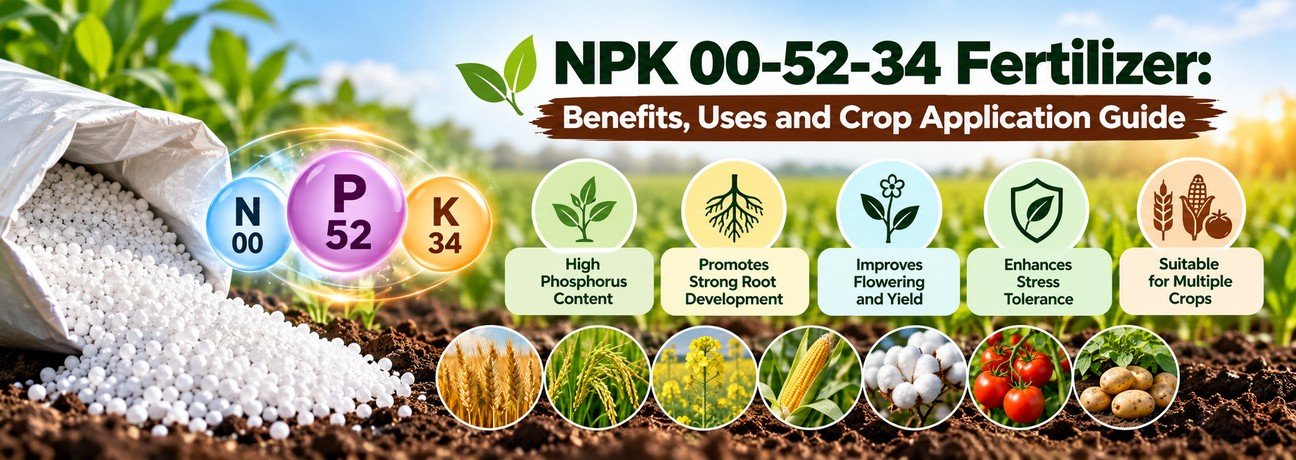
NPK 00-52-34 fertilizer is a fully water-soluble phosphorus-and-potassium fertilizer used when crops need strong reproductive support without additional nitrogen. The grade is commonly identified as mono potassium phosphate (MKP), supplying 52% phosphate as P2O5 and 34% potash as K2O, with no nitrogen.
Because it combines high phosphorus with high potassium, NPK 00-52-34 is often used around flowering, fruit set and fruit-development stages, as well as in fertigation programs where precise nutrient control is important. This guide explains what the grade does, when it fits best, how it differs from other NPK formulations, and how to use it more effectively.
What Is NPK 00-52-34 Fertilizer?
The numbers in NPK 00-52-34 describe the fertilizer's guaranteed nutrient analysis: 0% nitrogen, 52% phosphate and 34% potash. Agricultural grades are typically sold as highly soluble white crystalline material suitable for fertigation, drip irrigation and foliar feeding where the product label permits.
The absence of nitrogen is important. It allows growers to supply phosphorus and potassium without adding extra nitrogen at crop stages when excessive vegetative growth may be undesirable.
Why Phosphorus and Potassium Matter Together
Phosphorus and potassium perform different but complementary roles in crop development. The value of NPK 00-52-34 comes from supplying both in a concentrated, soluble form.
Phosphorus supports energy transfer and reproductive growth
Phosphorus is involved in energy transfer inside plant cells, root development and reproductive processes. Adequate phosphorus is especially important when plants are establishing roots and entering flowering or seed-forming stages.
Potassium supports water regulation and crop quality
Potassium helps regulate water movement, stomatal function and many enzyme systems. It is also closely associated with fruit filling, crop quality and stress management in many commercial crops.
No nitrogen gives growers more control
At certain stages, growers may want to raise phosphorus and potassium without encouraging additional leafy growth. A 00-52-34 grade makes that possible because it adds no nitrogen to the fertilizer program.
Benefits of NPK 00-52-34 Fertilizer
When matched to crop need, NPK 00-52-34 can provide several practical benefits in intensive crop nutrition programs.
- High phosphorus content: supports stages where phosphorus demand is important.
- High potassium content: supports water regulation, reproductive growth and crop quality.
- No nitrogen: allows P and K feeding without increasing nitrogen supply.
- Water soluble: suitable for many fertigation and drip-irrigation programs.
- Flexible application: many grades are suitable for both fertigation and foliar feeding.
- Useful during flowering and fruit development: often selected where a high P-K ratio is desirable.
When Should NPK 00-52-34 Be Used?
The best timing depends on crop stage, soil fertility and the rest of the fertilizer program. It is most useful when phosphorus and potassium are required while nitrogen demand is lower.
Before and during flowering
Growers often use high-phosphorus, high-potassium fertilizers around flowering because both nutrients are important during reproductive development.
During fruit set and fruit development
Potassium demand can increase as fruits develop. NPK 00-52-34 can fit into staged feeding programs where growers want to support fruit filling and quality without adding nitrogen.
In protected cultivation and fertigation
Its high solubility makes NPK 00-52-34 useful in drip irrigation, greenhouse and precision-fertigation systems where nutrient ratios are adjusted according to crop stage.
NPK 00-52-34 vs. Other Common NPK Grades
Choosing the correct grade depends on the nutrient balance required at a particular crop stage.
| Grade Main Nutrient Emphasis Typical Use | ||
| NPK 19-19-19 | Balanced N-P-K | General vegetative growth and balanced feeding |
| NPK 13-00-45 | Nitrogen + high potassium | Growth stages requiring potassium with some nitrogen |
| NPK 00-52-34 | High phosphorus + potassium | Flowering, fruit set and P-K focused stages |
| NPK 00-00-50 | Potassium only | High-potassium stages where no N or P is wanted |
No single grade is best for every stage. A crop can require different nutrient ratios as it moves from establishment to vegetative growth, flowering and harvest.
Using NPK 00-52-34 in Fertigation
Fertigation is one of the most common ways to use water-soluble NPK 00-52-34 because it allows nutrients to be delivered directly through irrigation water.
Good practice includes:
- Base rates on crop demand, soil tests and the existing fertilizer plan.
- Dissolve the product fully before injection.
- Use clean irrigation water and monitor EC where appropriate.
- Split the total nutrient requirement across multiple applications when suitable.
- Flush irrigation lines according to system requirements.
Bulkagrochem's product listing identifies its NPK 00-52-34 as water soluble and suitable for agricultural use, including soil and foliar programs.
Foliar Application of NPK 00-52-34
Foliar feeding can provide phosphorus and potassium directly to leaf surfaces, but concentration and timing matter. Bulkagrochem's current product guidance lists foliar use at approximately 500 g to 1 kg in 200 litres of water, with applications after crop establishment and again around flowering.
Always use the product label as the primary instruction because crop sensitivity, water quality and environmental conditions can affect safe concentration.
For best practice:
- Spray during cooler parts of the day.
- Avoid spraying crops under severe heat or water stress.
- Ensure even coverage rather than excessive runoff.
- Check compatibility before tank mixing with other inputs.
Mixing and Compatibility Considerations
NPK 00-52-34 is phosphate-based, so concentrated stock solutions should be handled carefully around calcium-containing fertilizers. Calcium and phosphate can react and form insoluble precipitates that may reduce nutrient availability or clog irrigation equipment.
In fertigation systems using concentrated stock tanks, calcium-containing fertilizers are typically kept separate from phosphate-rich fertilizers unless a verified compatibility procedure is used.
What If the Crop Is Deficient in Phosphorus or Potassium?
NPK 00-52-34 can help correct nutrient shortages only when phosphorus or potassium is genuinely limiting and the crop can absorb the applied nutrients.
Possible phosphorus deficiency signs
- Slow growth or poor crop establishment
- Weak root development
- Dark green foliage
- Purple or reddish pigmentation in some crops
Possible potassium deficiency signs
- Leaf-edge scorching or chlorosis on older leaves
- Weak stems
- Poor stress tolerance
- Reduced fruit quality in severe cases
Symptoms alone are not enough for diagnosis. Soil testing, tissue analysis and local agronomic advice are more reliable because pH, salinity, root disease and irrigation problems can produce similar symptoms.
Bulkagrochem NPK 00-52-34
Bulkagrochem supplies NPK 00-52-34 as a water-soluble fertilizer containing 52% phosphate and 34% potash. The product listing covers use across cereals, fruit crops, vegetables, pulses, oilseeds, sugarcane and ornamental crops.
For a wider comparison of soluble fertilizer options, buyers can explore the Bulkagrochem fertilizer range. Bulk purchasers can also use the website's contact and ordering options for current pricing and availability.
Common Mistakes to Avoid
Using it as a complete fertilizer
NPK 00-52-34 contains no nitrogen and does not supply calcium, magnesium or all micronutrients. It must be combined with other nutrients according to crop requirements.
Applying it only because the crop is flowering
Flowering does not automatically mean a crop needs more phosphorus or potassium. The correct decision should consider existing nutrition, soil status and crop response.
Ignoring total phosphorus and potassium supplied
Repeated applications can lead to unnecessary nutrient loading. Keep records and calculate the total seasonal nutrient contribution.
Mixing incompatible concentrated fertilizers
Avoid combining concentrated phosphate solutions with calcium-containing fertilizers unless compatibility has been confirmed.
Best Practices for Better Results
- Test where possible. Use soil or tissue analysis to confirm nutrient need.
- Match the grade to crop stage. Use 00-52-34 when high P and K with no nitrogen fits the program.
- Follow the label. Product concentration and crop recommendations vary.
- Use accurate fertigation calculations. Include all phosphorus and potassium supplied from other fertilizers.
- Check tank-mix compatibility. Especially with calcium-containing products.
- Monitor crop response. Adjust future applications based on plant growth, analysis and field performance.
Frequently Asked Questions
1. What is NPK 00-52-34 fertilizer?
It is a water-soluble fertilizer grade containing 52% phosphate and 34% potash, with no nitrogen. It is commonly identified as mono potassium phosphate or MKP.
2. When is NPK 00-52-34 commonly used?
It is often used around flowering, fruit set and fruit-development stages when crops need phosphorus and potassium without extra nitrogen.
3. Can NPK 00-52-34 be used in drip irrigation?
Yes. Water-soluble grades are commonly used through fertigation and drip-irrigation systems.
4. Can NPK 00-52-34 be sprayed on leaves?
Yes, suitable grades can be used as foliar sprays. Follow the current product label for concentration, crop suitability and timing.
5. Does NPK 00-52-34 contain nitrogen?
No. The first number is zero, so it does not contribute nitrogen to the crop program.
6. Can NPK 00-52-34 be mixed with calcium nitrate?
Concentrated phosphate and calcium solutions can form precipitates, so they are generally kept in separate stock tanks unless compatibility is specifically confirmed.
7. Is NPK 00-52-34 suitable for all crops?
It can be used across many crops, but the need for this nutrient ratio depends on crop stage, soil fertility and the complete fertilizer program.
Conclusion
NPK 00-52-34 fertilizer is a useful high-phosphorus, high-potassium fertilizer for crop stages where growers want to support reproductive growth without adding nitrogen. Its water solubility makes it especially practical for fertigation, drip irrigation and selected foliar programs.
The best results come from using it as part of a balanced crop nutrition strategy. Confirm the nutrient requirement, use the correct rate, check tank-mix compatibility and account for all phosphorus and potassium supplied throughout the season.
Need NPK 00-52-34 or other water-soluble fertilizers in bulk? Review Bulkagrochem's fertilizer range and contact the team for current availability, bulk pricing and purchasing support.