Hydrogel for agriculture is attracting attention as farmers look for practical ways to manage moisture around crop roots. These water-absorbing soil amendments can store some of the water received during irrigation or rainfall and release it as the surrounding soil dries. But they are not a substitute for sensible irrigation, and their performance is not the same in every field.
What does a hydrogel actually do? Which soils are most likely to benefit? How should you evaluate a product before investing in it? This guide explains the science in straightforward language and gives farmers, nurseries, and agricultural buyers a responsible way to assess its value.
What Is Hydrogel for Agriculture?
An agricultural hydrogel is a water-absorbing material made from a network of linked polymer chains. The network swells when it takes up water. When conditions become drier, some of that retained water may move back into the surrounding root zone.
How the water-absorbing structure works
Think of a hydrogel as a tiny reservoir mixed with soil, not a source of water on its own. It must first receive moisture from rainfall or irrigation. Its swelling and release behaviour depend on the polymer chemistry and the surrounding soil solution.
Hydrogel is not the same as fertilizer
Hydrogels are primarily used to manage moisture. They do not automatically supply nitrogen, phosphorus, potassium, or micronutrients. Some specially designed formulations can carry nutrients, but that should not be assumed for a standard water-retaining polymer. Maintain a crop-specific nutrient management plan.
Where Can Hydrogel Soil Amendments Be Useful?
The most promising situation is one where the root zone regularly dries between watering events. Even there, results can vary from crop to crop and season to season.
Light-textured and sandy soils
Sandy soils often drain more quickly than finer-textured soils. A suitable hydrogel may help retain water in the upper root zone, particularly where irrigation is intermittent. Soil texture, placement, application rate, and dissolved salts all influence the outcome.
Nurseries and transplanted seedlings
Nursery plants and young transplants have relatively small root systems. Moisture management near those roots is important during establishment. A properly selected soil amendment may be worth testing in a controlled nursery mix or transplant trial, while checking root aeration and drainage.
Rainfed or deficit-irrigated fields
Water-saving products are most relevant where crops experience a genuine moisture deficit. A 2026 University of Nebraska–Lincoln field report examined superabsorbent polymers in soybean under different water regimes. The researchers observed limited benefit under full irrigation and potentially greater value under water-limited conditions, while stressing that the results were from a single site-year and should not be generalized to every farm.
How Hydrogel for Agriculture Affects Soil Moisture
Research on agricultural hydrogels points to several interacting processes. Understanding them helps explain why an impressive laboratory swelling test does not guarantee an equally impressive field result.
Absorption, storage, and release
After a wetting event, a suitable polymer absorbs water and expands. As the surrounding soil becomes drier, a portion of that moisture may become available nearby. The amount actually accessible to roots depends on the soil's water potential and the hydrogel's own properties.
Soil texture, salinity, and water quality matter
The water-holding response can change with soil structure, irrigation-water salinity, fertilizer salts, and polymer formulation. A review in Agronomy for Sustainable Development describes variable results across soil types, while other research highlights contrasting effects on water movement and soil hydraulic properties.
Moisture retention is not a guaranteed yield increase
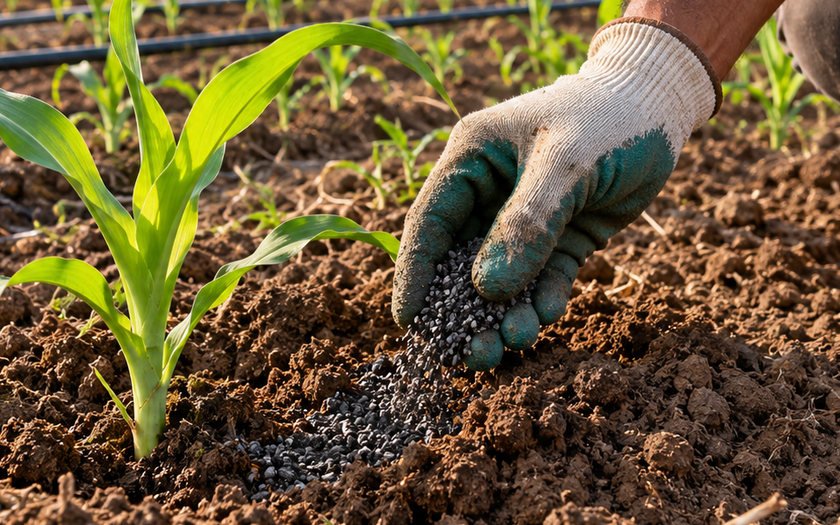
Even when a soil amendment changes water retention, yield may not improve if moisture is already sufficient or another factor limits the crop, such as nutrients, pests, heat, or poor drainage. This is why side-by-side farm trials are more informative than applying a product across the entire field immediately.
How to Use Hydrogel Responsibly in a Farm Trial
Before application, check the current product label and ask for technical guidance appropriate to your crop, soil, irrigation system, and local regulations. The following is a decision process—not a universal application prescription.
1. Confirm the exact formulation and instructions
Find out whether the material is intended for soil incorporation, potting media, planting pits, or another use. Check whether it should be applied dry or pre-hydrated, the stated application rate, storage conditions, safety instructions, and any compatibility limitations. Do not assume different hydrogel grades are interchangeable.
2. Position it where roots can benefit
Root-zone placement can matter more than simply spreading granules on the surface. Incorporation depth and distance from seeds or roots must follow the specific product guidance. Avoid excessive rates, which can alter the physical environment around roots as the material swells.
3. Keep irrigation and fertilizer decisions separate
Continue monitoring crop water needs and use your usual agronomic method to schedule irrigation. Do not reduce water or fertilizer solely because a supplier claims a fixed percentage saving. Granular polymers should not be injected into drip lines unless that exact formulation and equipment use are explicitly approved.
4. Compare a treated strip with an untreated strip
Set up comparable plots with similar soil, crop age, fertilization, and irrigation. Record soil moisture over time, irrigation dates, crop establishment, visible stress, yield if relevant, labour, and total costs. If possible, repeat across more than one irrigation cycle or season before scaling up.
Potential Benefits and Important Limitations
The most balanced way to assess hydrogel is to match a possible benefit with the conditions required for it to occur.
| Potential benefit | What to check before expecting it |
|---|---|
| More moisture held near roots | Soil texture, amendment placement, product chemistry, and water quality |
| Better establishment during dry intervals | Seedling stage, irrigation frequency, drainage, and a small trial comparison |
| Improved performance in water-limited situations | Whether water shortage is actually limiting growth; results are field-specific |
| Less water lost from some light-textured soils | Local soil behaviour, repeated wetting/drying cycles, and economic return |
Important: Neither a specific irrigation saving nor a crop-yield increase can be promised without product- and site-specific evidence. Synthetic and bio-based hydrogel formulations also differ in persistence and environmental profile; their composition and claims should be checked individually.
Checklist Before Buying Agricultural Hydrogel
Comparing only the price per kilogram can be misleading. A thoughtful purchase decision takes the entire use case into account.
- Application: Is the product designed for field soil, trees, nursery media, or another setting?
- Technical data: Is there a clear specification for chemistry, swelling behaviour, and use conditions?
- Water and soil: Has performance been evaluated under similar salinity, texture, and irrigation conditions?
- Safety and compliance: Are storage, handling, persistence, and any biodegradability claims documented?
- Practical economics: Do the trial benefits justify product cost, incorporation labour, and any changes to irrigation?
For a product-specific starting point, review BulkAgroChem's Hydrogel (Super Absorbent Polymer) listing and confirm the current instructions with the supplier before purchasing or applying it. You can also explore the wider BulkAgroChem agricultural product catalogue.
Frequently Asked Questions
1. What is hydrogel used for in agriculture?
Its main role is to help manage water retention in the growing medium or soil near roots. Suitability depends on the crop, soil, formulation, and moisture conditions.
2. Does hydrogel replace irrigation?
No. Hydrogel does not produce water; it absorbs water supplied by rainfall or irrigation. Irrigation planning and soil-moisture monitoring are still essential.
3. Which soils may benefit most from a hydrogel amendment?
Light-textured soils that drain quickly are often candidates for evaluation. Clay-rich or already well-watered soils may respond differently, and not all polymers behave alike.
4. How much hydrogel should be applied per acre?
There is no single safe rate for all products or farms. Use the current formulation-specific instructions and local agronomic advice; do not copy a dosage from a different brand, grade, or crop.
5. Can hydrogel be mixed with fertilizers or used through drip irrigation?
Compatibility must be established for the exact formulation. Never assume a granular hydrogel is suitable for injection through irrigation equipment. Follow label directions and check for clogging, swelling, or other compatibility risks.
6. Is every agricultural hydrogel biodegradable or suitable for organic farming?
No. Hydrogels can be made from different synthetic or bio-based materials, with different environmental characteristics. Ask for documentation and any relevant certification; do not infer organic suitability from the product name.
Conclusion: Test the Fit Before Scaling Up
Hydrogel for agriculture can be a useful soil-moisture management tool in selected conditions, especially where water is limiting and the soil or growing medium does not retain it well. But it is not a universal drought remedy. The right decision depends on credible technical information, product-specific instructions, and a small, measured farm trial.
Considering a hydrogel trial? Start with BulkAgroChem's Hydrogel (Super Absorbent Polymer) and discuss your crop, soil, irrigation water, and proposed application method before placing a bulk order.
Research and further reading
- Hydrogels for agronomical application: from soil characteristics to crop growth — Agronomy for Sustainable Development (2024)
- The impacts of bio-based and synthetic hydrogels on soil hydraulic properties — review (2022)
- Can superabsorbent polymers buffer soybean against drought? — University of Nebraska–Lincoln (2026)