Humic acid and fulvic acid are often mentioned together in agriculture, but they are not identical. Both belong to the broader group of humic substances formed from decomposed organic matter, yet they differ in molecular size, solubility and the way they interact with soil, nutrients and plant roots. Understanding humic acid vs fulvic acid helps growers choose the right input for soil conditioning, nutrient efficiency and crop support.
This guide explains the practical differences between humic acid and fulvic acid, their benefits, where each one fits best, how they can be used together, and what growers should consider before selecting a formulation.
What Are Humic Substances?
Humic substances are complex organic compounds formed during the long-term decomposition of plant and animal residues. In agriculture, they are commonly grouped into humic acid, fulvic acid and humin fractions.
Commercial agricultural products often use humic substances extracted from sources such as leonardite or other humified organic materials. Their value is mainly connected with soil chemistry, nutrient interactions and root-zone conditions rather than acting as direct replacements for NPK fertilizers.
Humic Acid vs Fulvic Acid: Main Differences
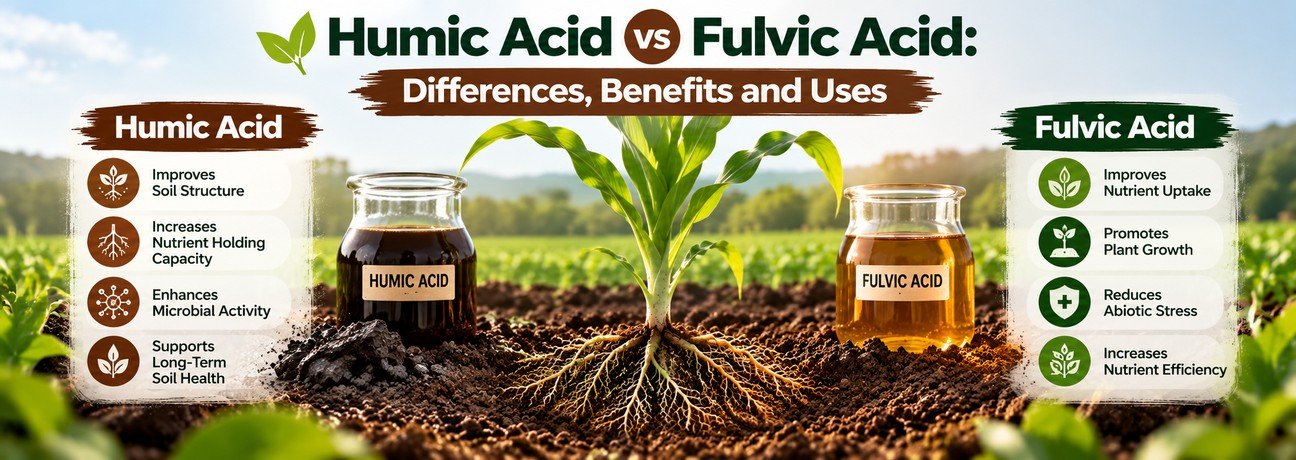
The simplest way to understand the difference is to look at molecular size and solubility. Humic acid generally contains larger molecules and is used more often for soil and root-zone applications, while fulvic acid contains smaller, more soluble fractions that are useful in nutrient transport and foliar applications.
 |
Benefits of Humic Acid in Agriculture
Humic acid is mainly valued for its interaction with soil and the root zone. It can contribute to a better environment for nutrient retention and root activity when used as part of a complete crop nutrition program.
Supports soil structure
Humic substances can interact with clay and organic matter, helping improve aggregation in some soil types. Better aggregation can support aeration, water movement and root development.
Improves nutrient retention
Humic acid contains negatively charged functional groups that can interact with positively charged nutrient ions. This can help improve the soil's nutrient-holding capacity and reduce rapid nutrient losses under suitable conditions.
Supports root-zone activity
Humic acid products are commonly used in root-zone programs because they can improve the chemical environment around roots and support the availability of certain nutrients.
Benefits of Fulvic Acid in Agriculture
Fulvic acid is typically more soluble and lower in molecular weight than humic acid. This makes it useful when growers want a product that can move readily in irrigation water or foliar spray solutions.
Helps nutrient mobility
Fulvic acid can form complexes with mineral nutrients, helping keep some of them more mobile and available in solution.
Suitable for foliar programs
Because of its smaller molecular size and high solubility, fulvic acid is commonly used in foliar applications and compatible nutrient programs where the label permits.
Useful in fertigation
Highly soluble fulvic formulations can fit well into drip and fertigation systems, provided the product is fully soluble and compatible with the irrigation setup.
Which Is Better: Humic Acid or Fulvic Acid?
Neither product is automatically better in every situation. The right choice depends on the agronomic objective.
- Choose humic acid when the main goal is soil improvement, root-zone conditioning or nutrient retention.
- Choose fulvic acid when the focus is nutrient mobility, foliar application or soluble fertigation programs.
- Use a combination when you want both soil-support and nutrient-mobility benefits from a single formulation.
Many commercial products intentionally combine humic and fulvic acids because the two fractions can complement each other in a broader crop-management program.
Humic and Fulvic Options from Bulkagrochem
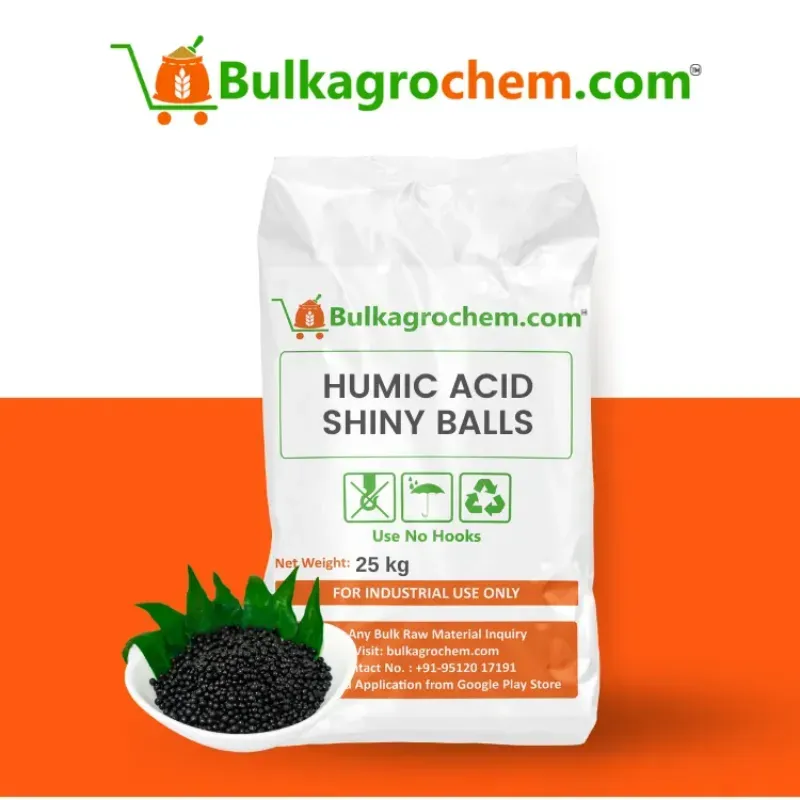
Bulkagrochem supplies humic-based agricultural formulations for crop nutrition and root-zone support. One available option is Humic Acid Liquid Formulation, which contains humic acid and fulvic acid in a combined liquid product.
Bulkagrochem also offers Humic Acid 98% Flakes, a water-soluble humic formulation designed for agricultural use.
Product concentration, solubility and application method should always be checked before use, especially when products are intended for drip irrigation or foliar spraying.
How to Apply Humic and Fulvic Acid
Soil application
Humic acid is commonly used through soil application, drenching or incorporation into the root zone. This method is most suitable when the objective is to improve soil conditions and nutrient retention.
Drip and fertigation
Water-soluble humic and fulvic products can be used through drip irrigation if the formulation is suitable and does not create sediment or clogging problems.
Foliar application
Fulvic acid is often preferred for foliar use because of its solubility and lower molecular size. Always follow label directions for concentration, crop stage and compatibility.
When Should Growers Use Humic or Fulvic Acid?
These products are most useful when they are selected for a specific field objective rather than applied automatically.
- During root establishment
- In soils with low organic matter
- When nutrient retention is a concern
- In fertigation programs where nutrient mobility is important
- During periods of active vegetative growth
- When combined nutrient and biostimulant support is required
Common Mistakes to Avoid
Humic and fulvic products can support crop programs, but they should not be treated as substitutes for proper fertilization or soil management.
- Do not replace NPK fertilizers: humic substances do not supply enough macronutrients to replace a balanced fertilizer program.
- Do not ignore soil testing: if the crop has a nutrient deficiency, the missing nutrient must still be supplied.
- Do not over-apply: follow the product label and recommended concentration.
- Check solubility: not every humic formulation is equally suitable for drip or foliar systems.
- Check tank-mix compatibility: especially when combining with fertilizers, micronutrients or crop-protection products.
Frequently Asked Questions
1. Is humic acid the same as fulvic acid?
No. They are both humic substances, but they differ in molecular size, solubility and how they behave in soil and nutrient solutions.
2. Can humic acid and fulvic acid be used together?
Yes. Many agricultural formulations combine them because humic acid supports soil and root-zone functions while fulvic acid supports nutrient mobility and solubility.
3. Which is better for foliar spray?
Fulvic acid is generally more suitable for foliar application because of its higher solubility and smaller molecular size, although the final decision should follow the product label.
4. Which is better for soil application?
Humic acid is commonly preferred for soil and root-zone use because of its larger molecular structure and role in soil conditioning.
5. Can humic acid increase fertilizer efficiency?
Humic substances can help improve nutrient retention and availability in certain soils, which may support fertilizer-use efficiency when the overall nutrition program is properly managed.
6. Can fulvic acid be used through drip irrigation?
Yes, many soluble fulvic formulations are suitable for fertigation, but product solubility and irrigation compatibility should be confirmed first.
Conclusion
The key difference in humic acid vs fulvic acid is not that one is universally better than the other. Humic acid is generally better suited to soil and root-zone conditioning, while fulvic acid is more useful where high solubility and nutrient mobility are important.
For many growers, a combined humic and fulvic formulation can provide the most practical balance. Bulkagrochem offers humic-based liquid and water-soluble products for agricultural use, giving growers and agri-input businesses multiple options depending on application method and crop requirement.
Looking for humic and fulvic acid products in bulk? Explore Bulkagrochem's agricultural formulations and select the product that best fits your soil, crop stage and application system.