



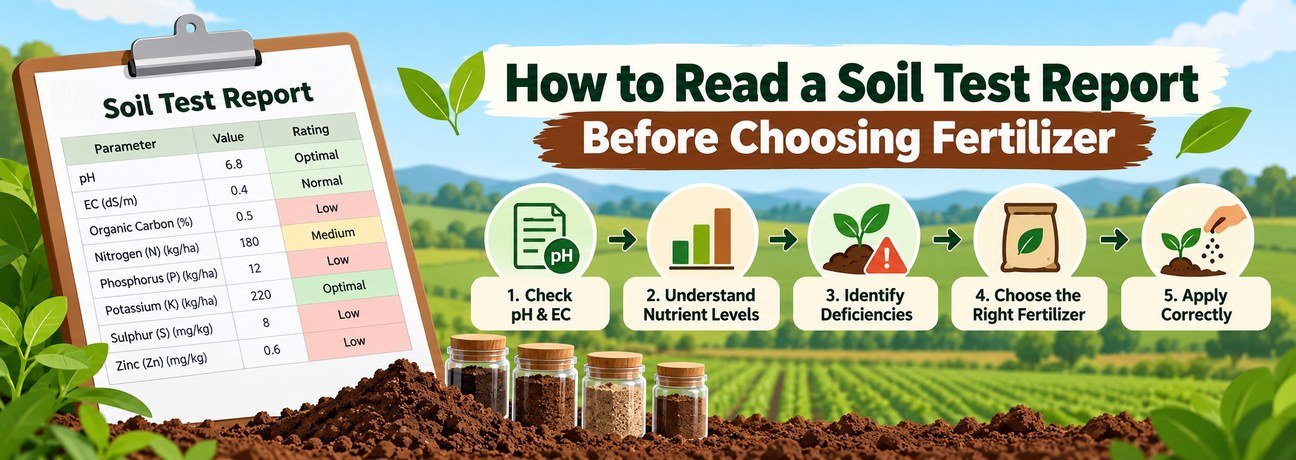
A soil test report can help you choose fertilizer more confidently, but only if you know what the numbers mean. Before buying an NPK blend, zinc product or soil amendment, examine the report alongside the crop you intend to grow, local soil conditions and the laboratory's recommendations.
Why soil testing should come before fertilizer selection
Two fields growing the same crop can have different nutrient needs. Soil type, irrigation water, previous fertilizer use, crop removal and pH all influence nutrient availability. A laboratory result is a starting point, not a universal prescription. Follow locally calibrated soil-test guidance whenever possible.
Start with the report details
Confirm the sample identification, collection date, sampling depth, crop and field area. If soil from different management zones was mixed into one sample, an average may conceal important differences. A report without a sampling history should be interpreted cautiously.
Understand the key soil test parameters
Soil pH
pH describes acidity or alkalinity. It influences nutrient availability and the behavior of certain soil amendments. Do not add lime, gypsum or acidifying materials simply because pH looks unfamiliar: the correct amendment depends on soil type, the underlying problem and local laboratory guidance.
Electrical conductivity (EC)
EC indicates soluble salt concentration under the test method used. Elevated salinity can affect water uptake, but thresholds differ by laboratory method, crop and soil. Look at units and extraction methods before interpreting a number.
Organic carbon or organic matter
These indicators provide context about soil organic material. They are not direct substitutes for a measured nutrient recommendation. Improving organic matter typically requires sustained soil-management practices rather than a single product application.
Available nitrogen, phosphorus and potassium
N, P and K support plant growth in different ways. Laboratories may show measured concentrations and categorize them as low, medium or high. Those categories are useful only with the testing method and local calibration. A soil marked 'high' in phosphorus does not automatically need another phosphorus-heavy fertilizer.
Secondary nutrients and micronutrients
Results may include sulfur, calcium, magnesium, zinc, iron, manganese, copper and boron. More is not always better, especially for micronutrients with narrow ranges between deficiency and excess. Confirm a deficiency and follow crop-specific recommendations before applying a corrective product.
Turn laboratory results into a fertilizer decision
- Identify the crop and growth stage: nutrient requirements differ for cereals, vegetables, fruit crops and other plantings.
- Check the lab recommendation: distinguish a measured nutrient value from a fertilizer application rate.
- Understand the units: mg/kg, kg/ha and percentage describe different things. Do not convert between them casually.
- Account for other sources: manure, compost, irrigation water and earlier applications may contribute nutrients.
- Choose the formulation and application method: a soluble fertilizer, soil-applied granular material and foliar product serve different roles.
- Check compatibility and label directions: avoid unverified tank mixes and use only permitted crops, rates and methods.
Common mistakes to avoid
- Buying a balanced NPK fertilizer when the soil test shows that only one nutrient needs correction.
- Assuming yellow leaves always mean nitrogen deficiency; pests, waterlogging, salinity and root damage can cause similar symptoms.
- Ignoring soil pH or EC while interpreting micronutrients.
- Using another region's critical values without checking local calibration.
- Applying micronutrients 'just in case' without evidence of need.
Example: choosing between NPK and micronutrient products
Suppose a laboratory identifies adequate phosphorus and potassium but flags a possible zinc shortage. Buying additional P and K may not address the issue. Discuss the zinc finding with an agronomist, check the method and crop, and consider an appropriate zinc product only if the recommendation supports it. Conversely, if the report identifies a real potassium requirement, an appropriate potassium fertilizer can be considered as part of the complete nutrient plan.
Bulk Agro Chem lists a selection of fertilizers and micronutrient products. Compare product specifications against the recommendation before placing an order; a product page cannot replace field-specific nutrient advice.
Frequently asked questions
How often should agricultural soil be tested?
Frequency depends on crop intensity, soil variability and local extension guidance. Test before major nutrient-management decisions and use a consistent sampling method to compare trends.
Can I choose fertilizer using only soil pH?
No. pH influences availability, but it does not provide a complete measure of plant-available N, P, K or micronutrients.
What does a 'low' nutrient rating mean?
It usually signals a greater likelihood of crop response under that lab's calibrated system. Ask the laboratory for the crop-specific recommendation and units.
Does high EC always mean soil is unsuitable?
No. The impact depends on the salinity test method, crop tolerance, drainage and irrigation-water quality. Consult local guidance.
Is a foliar spray a substitute for soil fertilization?
Not generally. Foliar nutrients may address specific needs, but cannot automatically replace a full soil-based nutrient program.
Should every crop receive boron or zinc?
No. Apply micronutrients based on evidence of need and suitable rates; excess application can be harmful.
Make the report actionable
Keep the report with field records, fertilizer receipts and crop observations. Bring the results to a qualified local agronomist or extension adviser before making major changes. To compare available fertilizer formulations and pack sizes, explore Bulk Agro Chem's fertilizer selection and confirm product suitability for your crop.
References and further reading
University of Minnesota Extension: Can soil health tests determine fertilizer needs? — explains why locally calibrated methods matter for fertilizer recommendations.