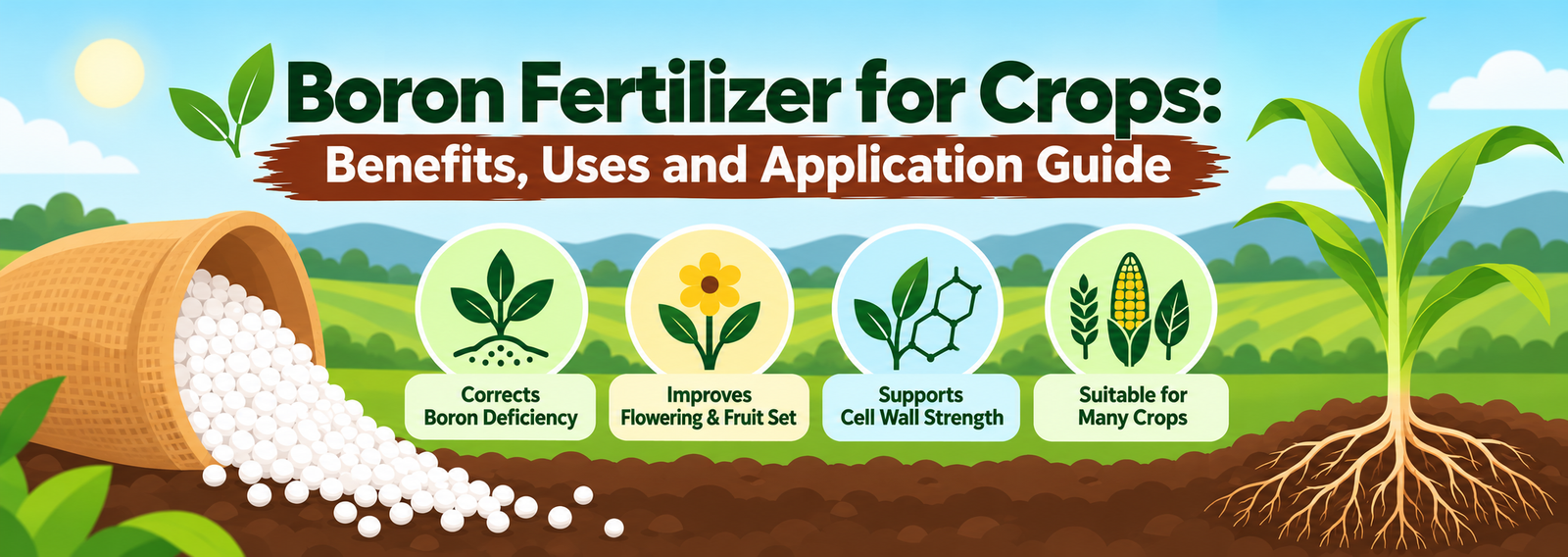
Boron Fertilizer for Crops: Benefits, Uses and Application Guide
Boron fertilizer is used to supply one of the essential micronutrients required in very small quantities for healthy plant growth and reproduction. Although crops need much less boron than nitrogen, phosphorus or potassium, a shortage can affect growing points, flowering, pollen development and fruit or seed formation. Because the gap between deficiency and excess can be narrow, boron should be applied carefully and based on crop need.
This guide explains what boron does in plants, common deficiency symptoms, when boron fertilizer may be useful, soil and foliar application methods, and the precautions growers should follow for safe and effective use.
What Is Boron Fertilizer?
Boron fertilizer is an agricultural nutrient input designed to supply plant-available boron. Depending on the formulation, boron may be supplied through borates, boric acid or other soluble sources suitable for soil application, fertigation or foliar spraying.
Boron is classified as a micronutrient because plants require only small amounts. That does not make it optional. Adequate boron supports several important physiological processes, particularly in actively growing and reproductive tissues.
Why Boron Matters in Crop Growth
Boron is involved in multiple plant functions, including cell-wall development, growing-point activity and reproductive growth. Its importance becomes especially visible during flowering and fruit or seed formation.
Supports cell-wall formation
Boron contributes to the structure and stability of plant cell walls. A shortage can therefore affect young leaves, roots and growing points where new tissues are being formed rapidly.
Supports flowering and pollen development
Boron is important for reproductive development, including pollen function and flower fertility. This is one reason growers often pay close attention to boron status around flowering in boron-responsive crops.
Supports movement and metabolism within the plant
Boron also participates in processes connected with sugar transport and normal plant metabolism. Adequate supply helps support balanced growth, but excessive boron can damage crops.
Potential Benefits of Boron Fertilizer
When a genuine boron deficiency exists, correcting it can support crop performance. The exact response depends on crop type, soil conditions, rainfall, irrigation, existing boron status and application rate.
- Supports healthy growing points: boron is important in rapidly dividing plant tissues.
- Supports flowering and pollination: adequate boron can help reproductive processes function normally.
- Supports fruit and seed development: boron nutrition is important in crops where reproductive growth is a major yield component.
- Complements micronutrient programs: it can be included with other essential micronutrients where testing indicates a need.
- Flexible application options: suitable products may be applied to soil, through fertigation or as foliar sprays.
Common Boron Deficiency Symptoms
Boron deficiency symptoms differ among crops, but they commonly affect young tissues because boron movement within plants can be limited in many species.
Damage to growing points
Young leaves may become distorted, brittle or poorly developed. In severe cases, terminal growing points may stop developing normally.
Poor root development
Root tips can be affected, reducing the plant's ability to explore soil effectively for water and nutrients.
Flowering or fruit-set problems
In some crops, inadequate boron may contribute to poor flowering, weak pollen performance or reduced fruit and seed development.
These symptoms can resemble other nutrient or environmental problems. Soil and tissue analysis are useful for confirming whether boron is actually limiting.
Where Boron Deficiency Is More Likely
Boron availability is influenced by soil texture, organic matter, moisture and rainfall. Deficiency risk is often greater in sandy or low-organic-matter soils where boron can be lost more easily.
Dry soil conditions can also reduce boron uptake because nutrient movement toward roots depends partly on soil moisture. High rainfall, on the other hand, can increase leaching in some soils.
Soil Application vs. Foliar Boron
Both soil and foliar application can be useful, but the right method depends on the crop, product and field conditions.
Soil application
Soil-applied boron can be useful where a field has a confirmed deficiency and a uniform correction is needed. Because the required quantity is small, even distribution is important.
Foliar application
Foliar boron can provide a direct route to leaves and flowers and may be useful at selected crop stages. Application concentration must be controlled carefully because excessive foliar boron can cause leaf injury.
Fertigation
Some soluble boron formulations can be used in fertigation systems. This approach can allow precise delivery, but irrigation uniformity and total boron concentration must be managed carefully.
Why Boron Application Requires Precision
Boron has a relatively narrow margin between deficiency and toxicity compared with many other nutrients. This means an application that is beneficial on a deficient field can become harmful if the crop already has adequate boron or if too much is applied.
Best practice includes:
- Use soil or tissue testing where practical.
- Follow the specific product label and crop recommendation.
- Measure low application rates accurately.
- Avoid repeated applications unless crop need is confirmed.
- Check water quality and tank-mix compatibility for foliar use.
- Keep records of all boron applications during the season.
Boron in a Complete Micronutrient Program
Boron should not be considered in isolation. Crops also depend on micronutrients such as zinc, iron, manganese and copper, and a deficiency in one nutrient cannot necessarily be corrected by supplying another.
For a wider overview of trace-element nutrition, read Bulkagrochem's guide to chelated micronutrients in agriculture. Growers and agricultural businesses can also explore the Bulkagrochem fertilizer range when planning broader crop nutrition programs.
How to Choose a Boron Fertilizer
Before selecting a product, compare the actual boron concentration and intended application method rather than choosing on product name alone.
- Boron percentage: confirm the concentration so the actual amount of elemental boron can be calculated.
- Solubility: important for foliar spray and fertigation systems.
- Crop suitability: check whether the product is recommended for the target crop and stage.
- Application method: select a formulation designed for soil, foliar or fertigation use.
- Compatibility: verify before mixing with fertilizers, pesticides or biological inputs.
Common Mistakes to Avoid
Applying boron without confirming need
Because excess boron can be toxic, routine application without evidence of need is not a sound approach.
Using inaccurate measurements
Boron is required at low rates, so measurement errors can have a larger impact than with many bulk fertilizers.
Trying to correct non-nutritional problems with boron
Poor fruit set, damaged growing points or weak roots may also be caused by drought, heat, salinity, disease or other nutrient imbalances. Correct diagnosis is essential.
Frequently Asked Questions
1. What does boron fertilizer do for plants?
It supplies boron, an essential micronutrient involved in cell-wall development, growing-point activity and reproductive processes such as flowering and pollen function.
2. When should boron fertilizer be applied?
Timing depends on crop need, soil status and product directions. Applications are often considered before or around important growth and reproductive stages when a deficiency has been identified.
3. Can boron fertilizer improve flowering?
Adequate boron supports normal reproductive development, including pollen function. However, applying boron will not improve flowering if the crop already has sufficient boron or if another factor is limiting growth.
4. Can boron be applied as a foliar spray?
Yes, many soluble boron products are suitable for foliar application. Follow the label carefully because excessive concentration can damage leaves.
5. What happens if too much boron is applied?
Excess boron can cause toxicity, including leaf-edge burn, chlorosis, reduced growth and yield loss. The margin between adequate and excessive boron can be narrow.
6. How do I know if my crop needs boron?
Use crop symptoms as an initial clue, then confirm with soil testing, tissue analysis and local agronomic recommendations where available.
Conclusion
Boron fertilizer can play an important role in crop nutrition when soil or plant boron is genuinely deficient. It supports cell-wall formation, growing points and reproductive development, making correct boron management especially important in sensitive crops.
The key is precision. Test where possible, select the correct formulation, apply only the amount required and follow product-specific directions. For growers and agricultural businesses building a complete nutrition program, Bulkagrochem offers crop-input options that can be evaluated alongside boron and other micronutrients.
Looking for bulk crop nutrition products? Explore Bulkagrochem's fertilizer and micronutrient portfolio and select formulations according to crop need, soil conditions and application method.