


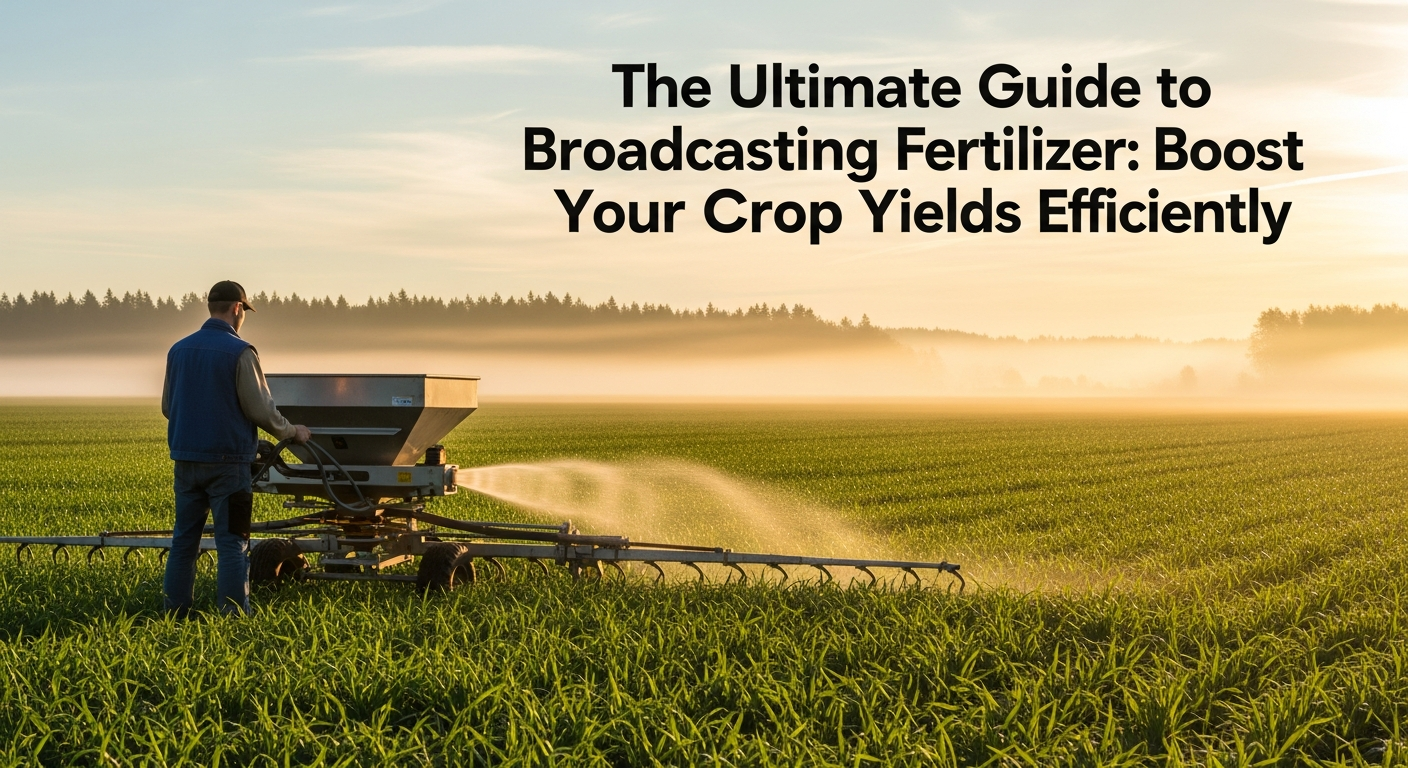
Fertilizer is a popular method of applying fertilizer to the soil since it has been around for centuries. Applying fertilizer via broadcast is the process of applying fertilizer uniformly across the ground surface so that plants (orchard crops) will receive all they need for proper growth and productivity levels. This is an easy, quick method to use when doing large farming operations.
Using proper broadcasting methods will increase soil health, provide an even amount of nutrients to plants, and increase crop yield. When the fertilizer is applied equally to the soil, the plant's roots can take up the nutrients better, which results in stronger root systems, healthy leaf structure, and better quality of crop harvests. Broadcasting fertilizers are typically used to fertilize cereal, grain, vegetable, and pasture crops.
Broadcasting fertilizer is a quicker method than other methods of applying fertilizer to larger areas (to cover more crop area) and will reduce the labor cost required to apply the fertilizer. You can apply broadcasting fertilizer manually or using equipment such as spreaders, GPS-guided equipment, or drones. The ability to apply broadcasting fertilizer using a variety of methods makes it possible for both small farmers and large-scale commercial agriculture to apply their fertilizer.
Farmers must understand how to improve their efficiency and decrease nutrient losses when using the principles of broadcasting applications, sustainable farming techniques, and precision agriculture technology. Using these methodologies will not only increase productivity but also maintain soil quality and protect the environment when fertilizing their crops.
Understanding Broadcasting Fertilizer: What It Is and How It Works
Broadcasting of fertilizer, sometimes referred to as "Broadening", is the process of applying the required nutrients (typically by means of fertilizer) uniformly over an area of land prior to planting or during planting. Farmers utilizing this technique are creating a uniform nutrient supply over a large area of land that supports healthy growth of all types of vegetables.
When employed properly, and on time, with the right fertiliser, and the right equipment; broadcasting fertiliser can produce effective results. Farmers often rely on irrigation or rainfall in conjunction with the broadcasting method to assist in moving the fertilizer into the soil and making it available to the crops for growing as well. The implementation of proper procedures for broadcasting will enhance crop yield and lower the waste of fertilisers.
Broadcasting Fertilizer Definition and Application Method
Broadcasting fertilisers refer to the uniform application of fertiliser by either manual or mechanical means to a field or fields. In addition to creating an even nutrient distribution, this procedure can assist in building both healthy soils and healthy crops across the entire field or fields.
How it Works:
- Uniform nutrient delivery across the field of agriculture.
- Large scale agricultural production.
- Quick and easy application of fertilizer.
- Increases crop balance throughout the entire field of agriculture.

Types of Fertilizer Broadcasting Techniques
Fertilizing techniques vary depending upon your farm size, crop type, and equipment you have. Common ways of applying fertilizer include: manual broadcasting, mechanical spreaders, and precision guidance systems.
Key Points:
- Manual broadcasting - applies small amounts of fertilizer over small areasTypically used on small farms
- Mechanical spreaders - covers larger areas and part or whole of the field can be covered by a spreader. Normally used for larger areas or fields.
- Precision - high degree of accuracy when applying fertilizers. Used for applying dry granular fertilizers.
Broadcasting Fertilizer vs Other Fertilizer Methods
Unlike efficient placement techniques like fertigation and foliar sprays that deliver nutrients into controlled locations within your crop's root zone, when utilizing broadcasting fertilizers, you're distributing products across a very large area (i.e., the entire surface of the field) rather than only at specific locations within your field.
Key Points:
- Effective across very large areas rapidly
- Generalized distribution versus concentrated
- General applications
- Operating on large tracts of farmlands.

Advantages of Broadcasting Fertilizer for Agricultural Productivity
Many farmers throughout the world appreciate the benefits of using broadcast fertilizers. Broadcast fertilizing allows nutrients to become available throughout the entire field, leading to more uniformly grown crops. Broadcast fertilizing can also reduce the amount of labor needed to fertilize a farm when compared to more focused methods of fertilizing.
Broadcast fertilizing is very effective for crops grown on large acreages, uses common modern farming equipment, and improves soil fertility, as well as nutrient absorption by crops; therefore, broadcast fertilizing generally has the most significant impact on improving farm productivity.
Improved Nutrient Distribution Across Fields
Broadcast fertilizer gives crops an even distribution of nutrients across the field helping them grow with an evenly balanced supply of nutrients for healthy growth.
Key Points:
- Even availability of nutrients
- Plenty of balanced roots development
- Even growth of crops
- Better access to fertilizer nutrients

Cost-Effective and Time-Saving Fertilization
Applying fertilizer using a broadcast process provides an effective and economical means of applying fertilizer to large agricultural fields quickly with very little hand labor required.
Key Points:
- Reduces application costs
- Ability to cover fields quickly
- Less manpower is required
- Can be used on a large agricultural farmland

Enhanced Soil Fertility and Crop Yield
Using the right techniques for applying fertilizers will help you keep a proper balance of nutrients in your soil and help to improve agricultural production.
Main Benefits:
- Improved Nutrient Levels
- Increased Growth
- Better Quality of Harvest
- Increased Yield of Produce
Best Practices for Effective Broadcasting Fertilizer Application
Utilizing fertilizers properly will maximize the efficiency of crops and minimize potential risk to the environment. Parts of the equipment that will affect the broadcasting of fertilizer include: the type of fertilizer, when you apply the fertilizer, and how the equipment is calibrated.
Farmers can ensure that they apply the correct rates of fertilizer using properly maintained equipment, thus ensuring that they distribute nutrients evenly among all crop plants in their field. The best method for the broadcasting of fertilizers and minimizing nutrient loss is to utilize soil testing and weather monitoring in conjunction with the recommended application rates.
Choosing the Right Fertilizer for Broadcasting
Granular and dry fertilizers are an excellent option for broadcasting applications due to their uniform and consistent distribution of nutrients throughout the soil.
Key Points:
- Granular fertilizers provide a leaf-level fertilizer source.
- Base fertilizer applications can be made quickly and easily.
- Slow-release options reduce fertilizer losses in the process.
- Easy to handle and store.

Correct Timing and Seasonal Application
Timing of fertilizer application dependent on plant growth stages will affect the amount of nitrogen crops will utilize from the fertilizers and how well they will respond to it.
Things to Consider:
- Apply Fertilizer Prior to Planting
- Apply Fertilizer to Growing Crops
- Avoid Applying Fertilizer During Heavy Precipitation Events
- Apply Fertilizer According to Crop Need
Equipment Calibration and Uniform Distribution
Calibrating properly helps to ensure even spreading of fertilizer and eliminates any inconsistencies in nutrients applied.
Advantages of Uniform Distribution & Equipment Calibration:
- Increase accuracy of application
- Prevent excessive application of fertilizer
- Minimize waste of fertilizer
- Allows for uniform growth of crops.

Common Challenges and How to Overcome Them in Broadcasting Fertilizer
While broadcasting fertilizer can be very effective, applying too much fertilizer, applying it improperly, or using poor-quality equipment may cause some loss of nutrients into the environment or uneven crop production; this may also happen if the weather is not suitable for application; thus not producing the maximum amount of possible crop yield.
Farmers can use sustainable practices, soil monitoring and precision agriculture technologies to help overcome these challenges and achieve optimal fertilizer management.
Preventing Fertilizer Runoff and Nutrient Loss
The washing away of fertilizers before plants absorb them is known as nutrient runoff.
Things to Keep in Mind:
- Do not use prior to receiving a large amount of rain
- Select fertilizers with Slow-Releasing properties
- Use recommended amount of fertilizer
- Incorporate Fertilizers into the Soil if applicable

Managing Uneven Fertilizer Distribution
Inconsistent fertilisation and inconsistent planting could result from irregularly distributing chemicals over the soil surface.
Key Points in Controlling Chemical Uniformities in the Crop Production System would include:
- Regular Calibrating of Application Equipment
- Using Quality Application Equipment
- Monitoring Spreading to Establish Consistent Spreading pattern
- Avoid Spread Conditions With Wind Speed Greater Than 10 M.P.H. (15 K.P.H)

Environmental Concerns in Broadcasting Fertilizer
Poor handling of fertilizer will have an adverse effect on the quality of both soil and water.
Through broadcasting fertilizer, there are several ways to help protect the environment:
- Reducing excess fertilizer application.
- Using sustainable agricultural practices.
- Implementing precision agriculture technology.
- Protecting adjacent water bodies.
Comparing Foliar Spray vs Broadcasting Fertilizer Methods
In terms of their roles within the larger context of crop nutrition, both foliar spray and broadcasting fertilizer have vital parts to play. In general, broadcasting fertilizers supply the basic nutrition needed for crops over the entire field, while foliar spray fertilizers provide an easy-to-absorb source of nutrition for crops through direct leaf contact.
By knowing the difference between foliar spray and broadcasting, growers can then develop the best overall fertilizer program. Using both methods of delivering nutrients to the growing crops will usually provide a grower with nutrient delivery that is both balanced and efficient.
Benefits of Foliar Spray Fertilizer
Fertilisers in the form of foliar sprays allow for quick absorption of nutrients via the leaf surface, which can be a great way to relieve deficiencies quickly.
Key Points:
- Rapid uptake of nutrients
- Deficiency relief immediately
- Efficient micronutrient delivery
- Reduced reliance on soil

Broadcasting Fertilizer for Large-Scale Nutrient Supply
Fertilizer broadcasting offers an excellent way to get nutrients on a large scale.
Some of the following points may help:
- Covering large areas of farmland.
- Ability to apply fertilizer on the base.
- High efficiency for cereals/grains.
- Providing a long-term supply of nutrients.

Foliar Spray vs Broadcasting: Which Is Better?
Crop type. Nutrient requirements and farming goals will determine the best fertilizer method to use.
Important Notes:
- Quick fix via foliar spray.
- Soil nutrition via broadcast.
- Mixing will improve efficiency.
- Maximize results through precision farming.

Innovations and Technologies Improving Fertilizer Broadcasting
Innovations and technology are improving how fertilizers are applied in today’s agriculture through automation, precise farming, and advanced management systems for nutrients.
Fewer nutrient inputs, reduced nutrient wastage, and supporting sustainable farming practices are now feasible due in large part to technology. By using these technologies, farmers can apply fertilizer to their crops earlier and better monitor the nutrient requirements of their crops, allowing them more control over meeting those requirements.
GPS-Guided Fertilizer Spreaders
GPS technology helps improve the accuracy of fertilizer spreaders by reducing overlap and improving efficiency compared to traditional methods of applying fertilizer.
There are many advantages of GPS Fertilizer Spreaders:
- Increase precision to fields where fertilizer has been used
- Reduce the waste of fertilizer used in agriculture
- Make more efficient use of fertilizers and nutrients
- Supports the application of Precision Agriculture concepts.

Drone and Smart Broadcasting Technology
Efficient application of fertilizers in challenging environments is being realised through the use of aerial drone technology and smart broadcasting systems.
Key features of the use of drone & smart broadcasting technology:
- Coverage of inaccessibly located areas
- Improved operational delivery speed
- Decreased labour requirement,
- Increased accuracy of application.
Sensor-Based Nutrient Management
The purpose of sensors is to assist farmers in monitoring their soil's conditions as well as optimizing the use of fertilizer.
Sensor-Based Nutrient Management major characteristics:
- Real time nutrient monitoring
- Precision nutrient management
- Minimizing excess use of fertilizer
- Sustaining agriculture in a healthy manner.

FAQs
Q1. What is broadcasting fertilizer?
Broadcasting fertilizer refers specifically to applying a fertilizer (plant food) uniformly across the soil on top of the ground and it will regenerate crops back to top-dressing.
Q2. What are the benefits of broadcasting fertilizer?
Broadcasting (application of fertilizer) will achieve an even distribution of nutrients and promote healthier plant growth.
Q3. How is foliar spray fertilizer different from broadcasting fertilizer?
A foliar spray refers to a liquid application of fertilizer to the plant leaves, whereas broadcasting is an application of fertilizer only to the soil surface.
Q4. When should broadcasting fertilizer be applied?
Fertile soils generally receive fertilizer before planting, however there are times it is necessary to broadcast fertilizer to help improve crop yields during the early growing season.
Q5. Can broadcasting fertilizer cause nutrient loss?
Yes, there is some chance that natural elements may cause loss of nutrients (e.g., runoff, leaching, water evaporation) due to either improper application or over-application of fertilizer.
Conclusion: Embrace Broadcasting Fertilizer to Maximize Your Agricultural Productivity and Sustainability
Broadcasting fertilizer is among the most effective and most utilized forms of fertilizer application in Agriculture. Broadcasting fertilizer allows efficient coverage of plant nutrients, enhances soil fertility, and promotes an increase in crop production on large areas of farmland. Broadcasting fertilizer can be a very significant contributor to farming success for many farmers and it is very often combined with the proper timing and calibration of the application equipment, as well as soil management practices.
Knowing the difference in method between foliar spray fertilizer and broadcasting fertilizer will help producers decide the best means of applying fertilizer to their crops. On the one hand, foliar spray fertilizers have the ability to provide nutrients to crops rapidly; conversely, broadcasting fertilizer has the ability to provide nutrients to the soil over a more extended time period. Therefore, by using both applications of fertilizer, producers can develop a comprehensive nutrient management program.
